If you have spent any time researching wedding videographers this past year, you have probably met the question, asked openly or hinted at in comments and forums: is artificial intelligence going to replace wedding videographers?
It is a fair question. As someone who edits wedding films for a living, I think it deserves an honest answer — not a defensive one, not a dismissive one, and not the kind of marketing non-answer that avoids the uncomfortable parts.
So here it is: what AI can already do for a wedding film, what it cannot do, and what that means for you as a couple choosing who will tell the story of one of the most important days of your life.
The Real Question Is Not If. It Is When.
Most conversations about AI and video start in the wrong place.
The question is not whether AI will one day be able to edit video. It already can. Tools that cut footage automatically, sync multicam audio, generate subtitles, create social reels, match colour to a reference frame and translate voiceovers into dozens of languages exist now, and they work.
The real question is different: when will AI be good enough to replace the repetitive, standardised editing that fills a large part of the video industry?
My honest view, as someone who uses these tools every week, is that we are closer than most of the wedding industry is willing to admit. Within the next year or two, AI will handle all of this extremely well:
- smart automatic cuts based on content and rhythm;
- multicam synchronisation of long recordings;
- accurate subtitles in several languages;
- social-ready reels generated from raw footage;
- edits cut to the beat of the music;
- natural-sounding voice translations;
- simple graphics and titles from a written prompt.
I am not talking about cinema or high-level storytelling. I am talking about the 70 to 80 per cent of standard, repetitive video work that still takes hours of human time today. That work is going to change, and pretending otherwise does a disservice to anyone trying to make an informed decision about their wedding.
What AI Actually Does Well Right Now
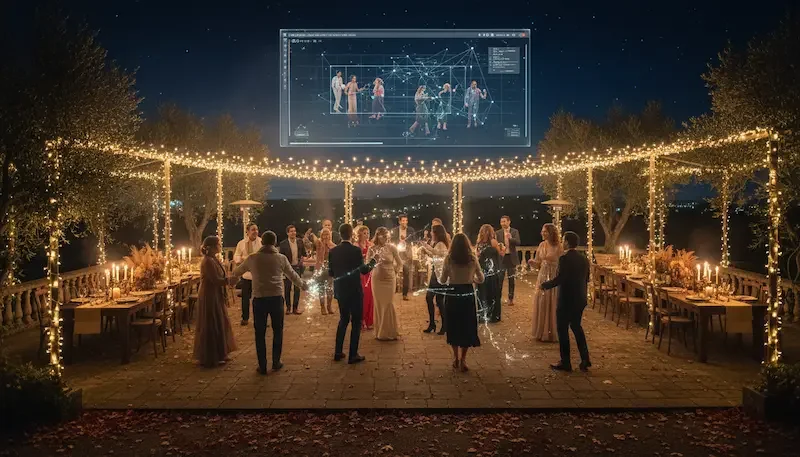
AI can create a visual effect. A filmmaker gives it meaning.
Let me be open about my own workflow, because couples deserve to know how the people they hire work.
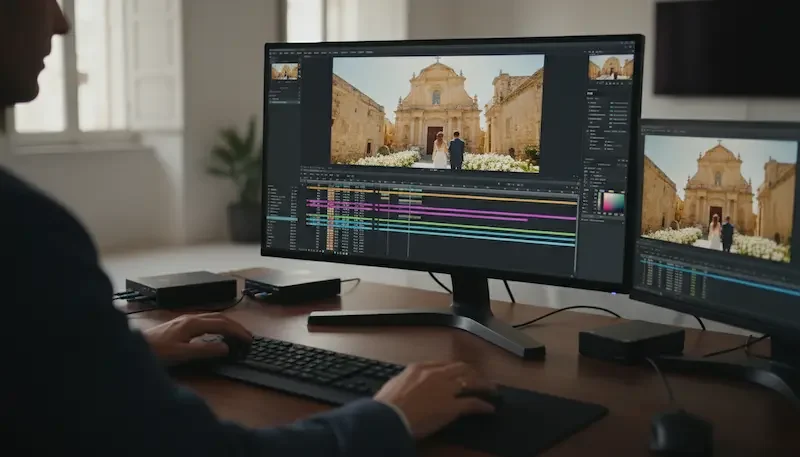
I already use AI in parts of my post-production. Not for storytelling, and not for the emotional core of a film, but for the genuinely tedious parts of the job, where a machine is faster and more consistent than a person without anything meaningful being lost.
- Syncing audio across cameras
- With three cameras and a separate audio recorder on a ceremony, syncing everything used to take an hour or more. AI-assisted tools do it in minutes, accurately.
- Transcription and subtitles
- Speeches, vows and readings can now be transcribed very accurately in several languages, which matters enormously for international couples whose guests do not all speak the same language.
- Organising the raw footage
- Finding the best laugh, the clearest tear, the cleanest take of the first kiss is getting faster with AI-assisted review. It does not choose the moment; it speeds up finding the candidates.
These are tools. They save time. They do not change the film, the story, the person behind the camera or the person making the creative choices.
What AI Cannot Do — And Will Not Do Soon
This is where the conversation gets interesting, and where I think many couples are being misled.
A wedding film is not standard video content. It is not a podcast cut, a social reel or a product demo. It is emotional storytelling about two specific people on the most important day of their lives, and that is a kind of work AI is nowhere near solving.
AI cannot be present on your wedding day. It cannot read the room or sense when something meaningful is about to happen. It cannot feel the silence before a father begins his speech, the glance between you before the ceremony, the moment a grandmother reaches for her handkerchief. Those moments need a person who is physically there, paying attention and deciding in a split second where to point the camera.
AI cannot make editorial choices rooted in your story. It can cut to the beat of a song. It cannot decide that the most powerful moment of your film is a three-second pause in which nothing happens but a look. That intuition comes from having been there, from having talked to you beforehand, from understanding who you are and what matters to you.
AI cannot direct the unspoken rhythm of a day. Good wedding filmmaking is not only post-production; it is the quiet work of knowing when to move, when to wait and when to step back. A filmmaker who knows the light at Villa Mon Repos at golden hour, or the way the stone of Ragusa Ibla holds the last sun, is making decisions no algorithm can make.
AI cannot build trust. Couples let us into extraordinarily intimate moments because they have talked with us and felt that we care about their story. That relationship is the foundation of every great wedding film, and it is not a technical problem.
What This Means for the Videographer — And for You
I do not think wedding videographers are going to disappear, but the role is going to change, and quite quickly.
The videographer of five years ago spent most of the time on the timeline: cutting clips, syncing audio, correcting colour, exporting social versions, adding subtitles. The videographer of five years from now will spend less time there and more on what AI cannot replace — being present on the day with focus and intention, making creative decisions, shaping the emotional arc of the film, and genuinely understanding the couple whose story it is.
The shift is from timeline operator to creative director and AI supervisor.
For couples this has a practical consequence. The questions worth asking a videographer today are not the ones that mattered five years ago. Whether someone has the right software or enough editing hours per film tells you little. What matters now is:
- how they think about your story;
- how present they will be on the day;
- how they make creative decisions;
- what they choose to include, and what they leave out;
- whether they can show you full films, not just 90-second highlight reels, in which the editorial choices make sense.
These questions separate a videographer from a video operator, and they will matter even more as AI takes over the technical layer. For more of them, read Booking a Wedding Videographer in Sicily.
The Risk Is Not the Technology. It Is the People Who Use It Poorly.
This is the part I think is most honest.
The real risk for couples is not that AI will one day make wedding films. It is that some videographers are already leaning on automated tools to make up for a lack of craft: templated edits, generic music matched by algorithm, the same colour grade on every film whatever the setting, subtitles dropped over the footage with no thought for rhythm or composition.
Those films look fine at a glance. They look terrible when you watch them in ten years and realise they could have been anyone’s wedding. A film like that is not ruined by AI but by the absence of a real person making real decisions; AI just makes it faster and cheaper to produce, so there will be more of them.
When you choose a wedding videographer, what you are really choosing is a person with taste, intuition and presence. Not a software stack. A person.
A Final, Honest Word
I use AI in my work, and I will use more of it as it improves. Any videographer who tells you they do not, or never will, is either not telling the truth or being left behind — and neither is reassuring.
But couples from across Europe and as far as Australia do not travel to Sicily to have their wedding filmed by a team from Ragusa because of our software. They come because we show up on the day, pay attention and care; because we bring years of watching weddings unfold in this particular light, on this particular island; and because we know where to stand and when to press record.
That cannot be automated — not now, and probably not in our lifetime. The best videographers have always been storytellers first. They will be the ones who last, and the ones worth hiring.
Will AI replace wedding videographers?
Not the ones who tell stories. AI is already taking over much of the repetitive editing work, such as syncing, subtitles and automatic cuts, but it cannot be present on the wedding day, read the room or make editorial choices rooted in a couple’s story.
Does Film Vision use AI in its wedding films?
Yes, for technical tasks: syncing audio across cameras, transcription and subtitles in several languages, and organising raw footage. The storytelling, the creative decisions and the presence on the day remain entirely human.
What should I ask a wedding videographer about AI?
Ask how they think about your story, how present they will be on the day, how they make creative choices, and whether they can show you full films rather than highlight reels. Those answers matter more than which software they use.
Looking for a storyteller, not a software stack?
If you are planning a destination wedding in Sicily and want your story told with presence, craft and honesty, we would love to hear from you.
Get in touch