Sicily is not just a destination. It is a feeling.
An island at the crossroads of three continents, with Greek temples on one coast and Arab-Norman cathedrals on the other. A landscape that moves from volcanic summits to Baroque towns to some of the clearest sea in the Mediterranean, all within a two-hour drive. And a light that has drawn filmmakers, painters and poets for centuries.
For a growing number of international couples, especially from the US, the UK, Australia and across Europe, Sicily has become one of the most desirable places in the world for a destination wedding. Not because it is fashionable, but because it is extraordinary.
This guide covers everything you need to plan a wedding in Sicily: the best places, the most beautiful venues, the ideal season, a realistic picture of costs, and what to look for in the team that will shape your day — and the film that will let you relive it for the rest of your lives.
Why Sicily for a Destination Wedding
Sicily offers something that most Italian destinations — Tuscany, the Amalfi Coast, Lake Como — increasingly cannot: the feeling of somewhere discovered, not curated.
The island has not been polished into a wedding-industry product. Its Baroque towns are genuinely old, lived in and Sicilian. The countryside still works — olive groves, vineyards, old farmsteads held by the same families for generations. The landscapes are raw, and the cooking is one of the great culinary traditions of the Mediterranean.
In a single day you can move from the cliffs of Taormina to the Baroque gold of Noto, from the volcanic drama of Etna to the clear water of Cefalù, from the honey-coloured palaces of Ortigia to the white cubic houses of Panarea. Each place tells a completely different story. For couples who want a wedding that feels real, rooted in a living culture and a landscape with history and texture, Sicily is hard to beat.
Four qualities in particular set a Sicilian wedding apart from any other in Italy:
- The light
- An intensity and tonal range that photographers and filmmakers describe as unique in Europe, from the silvery mornings of the north coast to the deep gold of late afternoon in the south-east.
- The authenticity
- Unlike places reshaped by tourism, Sicily is still genuinely itself, and your guests feel it the moment they arrive.
- The variety
- No other Italian region combines coast, countryside, volcano, Baroque towns, archaeological sites, vineyards and fishing harbours in such a compact area.
- The value
- Compared with Tuscany or the Amalfi Coast, Sicily offers extraordinary quality at significantly lower cost.
The Best Places to Get Married in Sicily
An honest overview of the main wedding destinations on the island, from the most iconic to the most authentic, each with its own character, its own light and its own cinematic possibilities.
Ragusa and Ragusa Ibla
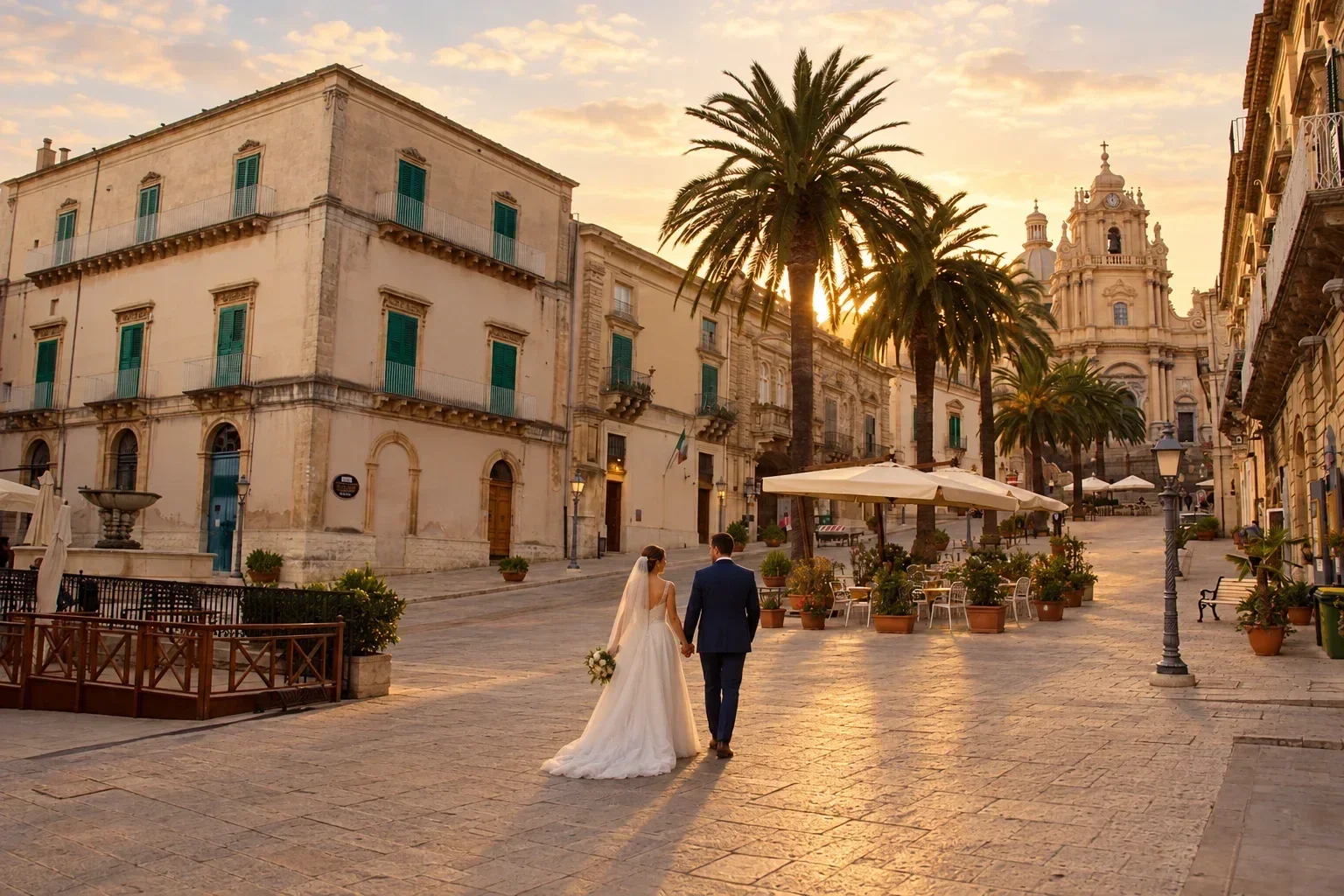
Ragusa, and above all its Baroque lower town, Ragusa Ibla, is one of the most extraordinary wedding destinations in Sicily: a UNESCO World Heritage town on the Iblean plateau, with honey-coloured palaces, dramatic staircases, panoramic terraces and an atmosphere of quiet aristocratic elegance. The province is also home to some of the island’s most celebrated venues — Castello di Donnafugata, Villa Criscione, Villa Fegotto, Villa Anna, Villa Matilde, Villa Gerosa — covered in our guide to wedding venues in Ragusa.
Film Vision is based in Ragusa, and we consider it the most cinematically rich wedding destination in Sicily.
Taormina
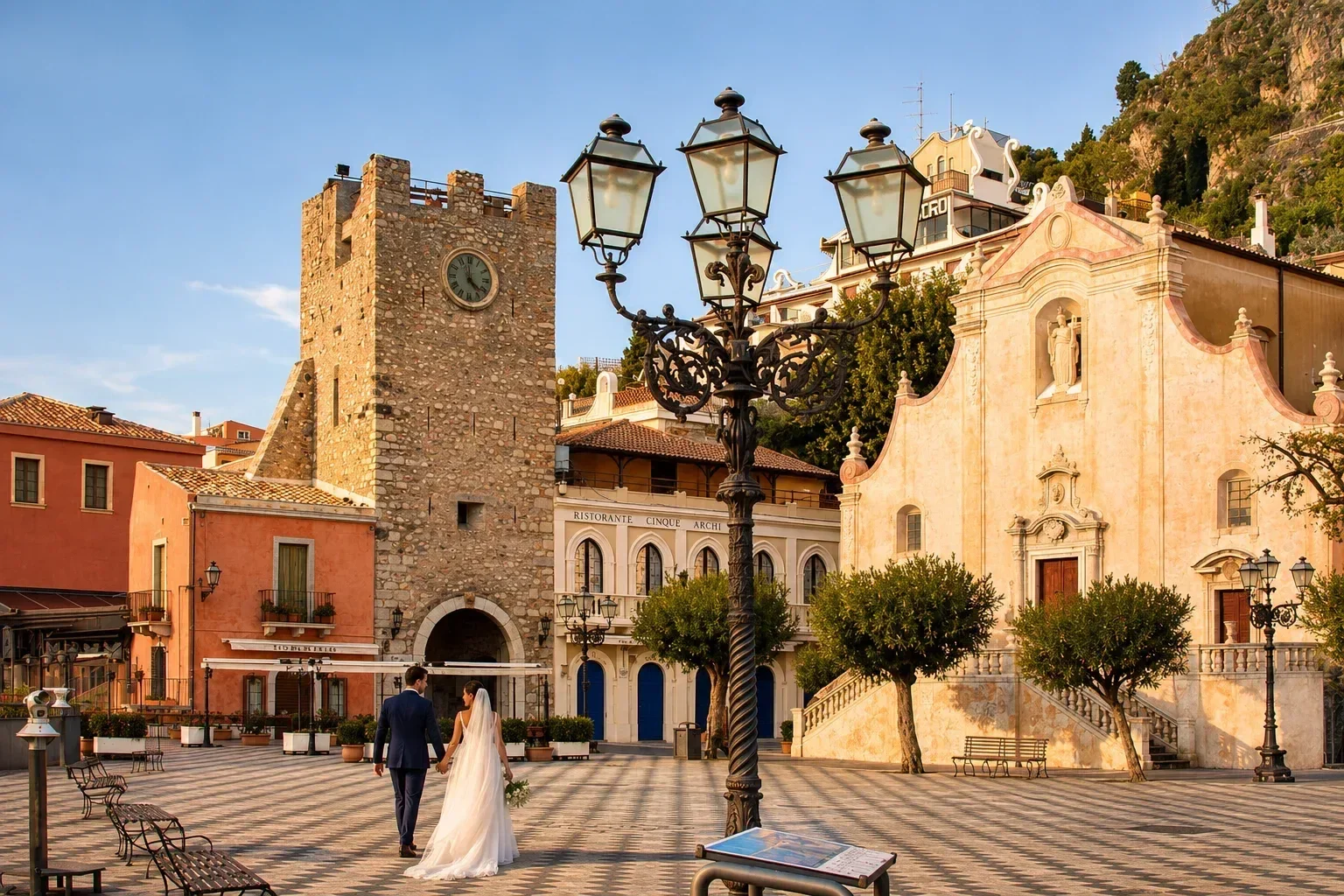
Taormina is arguably Sicily’s most iconic wedding destination: a clifftop town above the Ionian Sea, with Etna behind it and the ancient Greek Theatre as one of the most spectacular settings in Europe. Home to some of the island’s most exclusive hotels — the Belmond Grand Hotel Timeo, San Domenico Palace and Villa Sant’Andrea — it is the answer for couples who want Sicily at its most glamorous. See our guide to the best wedding venues in Taormina.
Noto and the Val di Noto
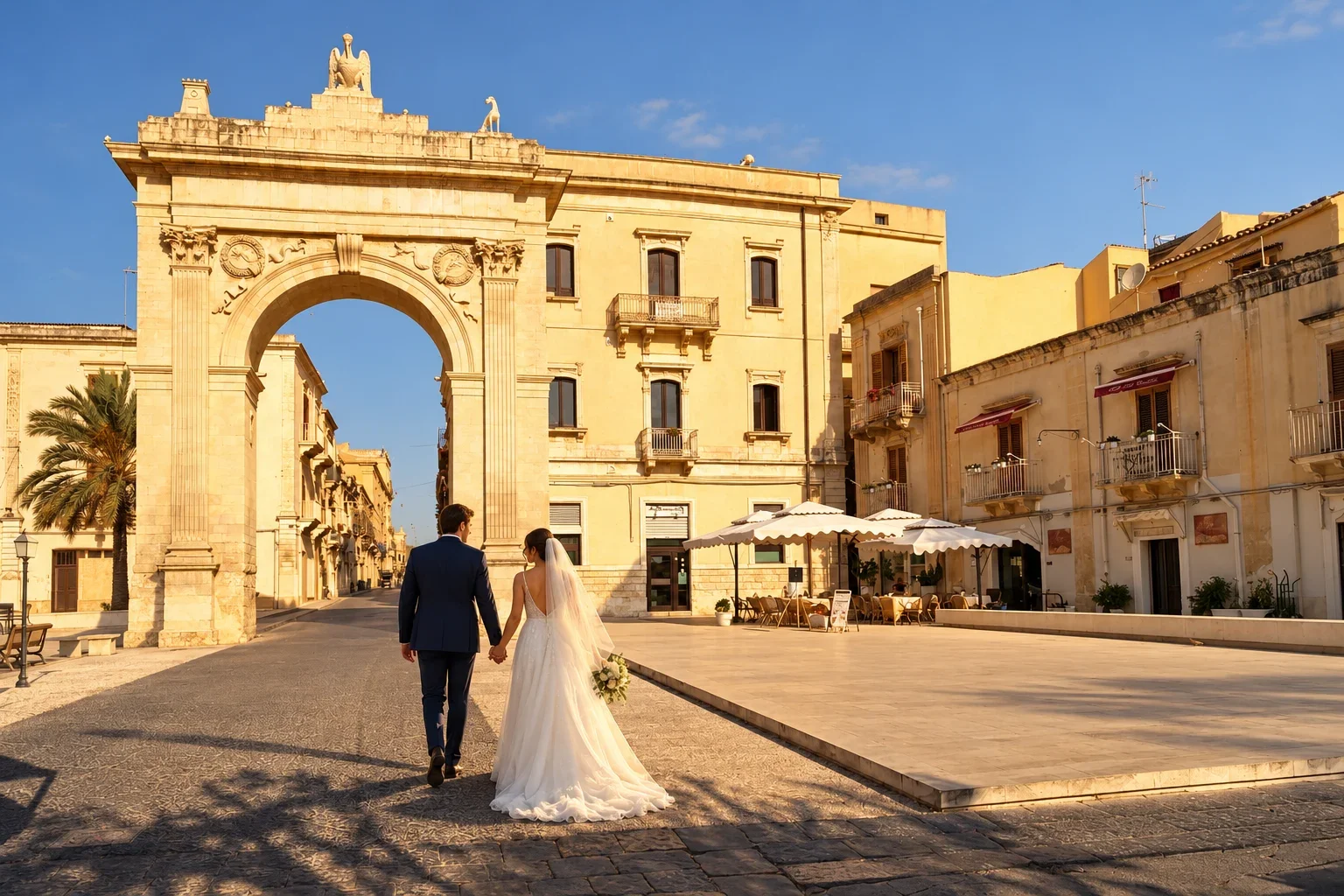
Noto is the Baroque capital of the south-east, a UNESCO-listed town that glows honey-gold in the afternoon light, with its cathedral, noble palaces and intimate piazzas. The Val di Noto around it has an extraordinary density of venues, from the design-led luxury of Dimora delle Balze to the working countryside of Feudo Bauly — ideal for refined beauty, warm tones and an intimate atmosphere.
Further west, Modica, a Baroque town built inside a ravine and famous for its chocolate, and Scicli, quieter and close to the sea, share the same UNESCO listing and lie fifteen minutes apart. Both reach the coast within twenty minutes, which makes a Baroque ceremony and a golden hour on the beach easy to fit into a single day.
Syracuse and Ortigia
Syracuse and its ancient island heart, Ortigia, form one of the most layered wedding destinations in Sicily: a city where Greek columns stand inside a Baroque cathedral, where alleys open suddenly onto the sea, and where every corner holds a story three thousand years old. For couples who want depth and history at the centre of their day, it is incomparable.
Cefalù and the Northern Coast
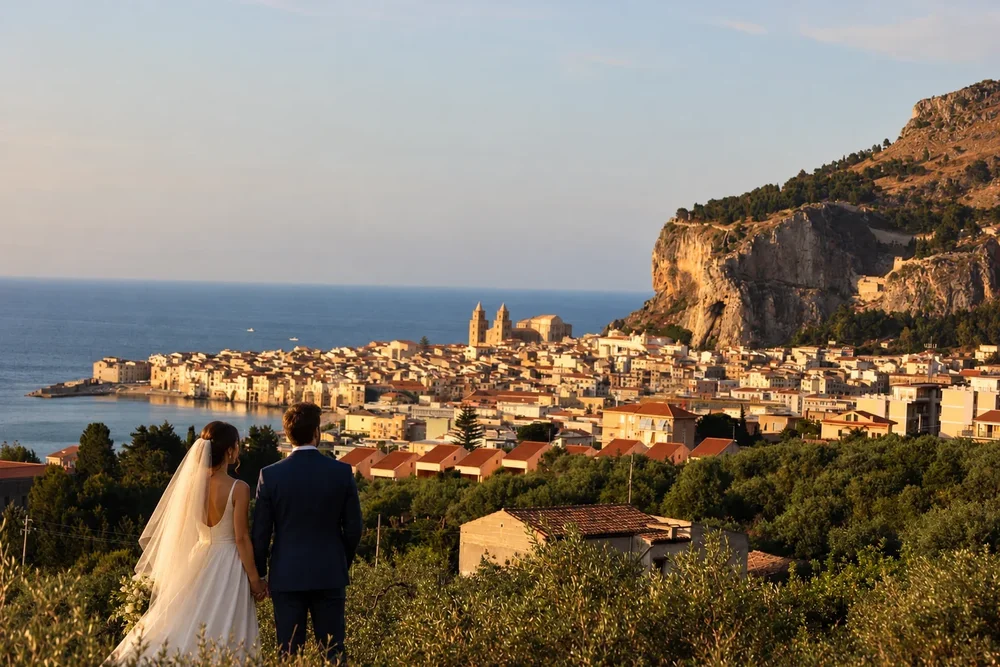
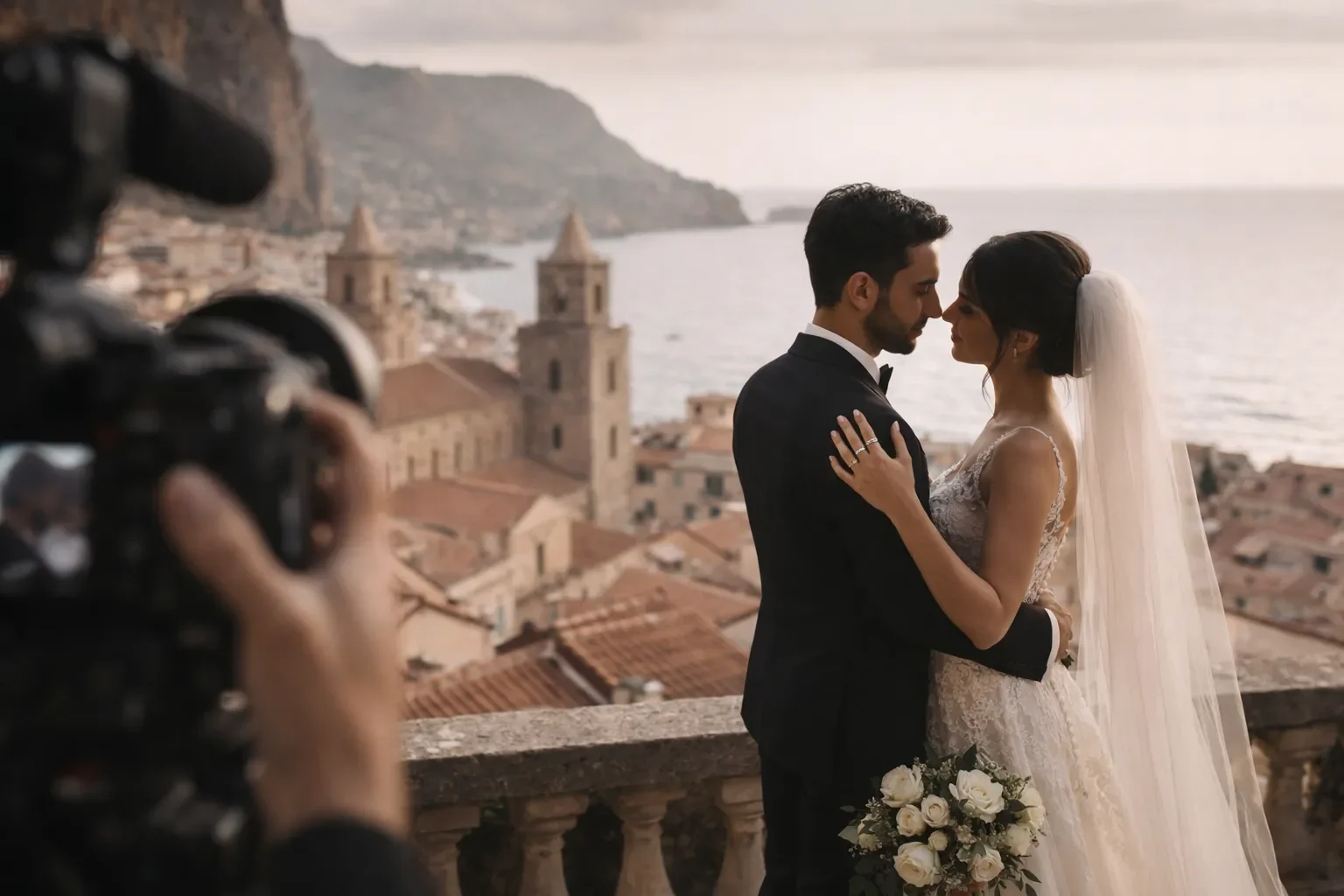
On the northern coast, Cefalù has a uniquely romantic atmosphere — a Norman cathedral above a medieval town, cobbled alleys running down to a crystalline sea, and La Rocca above one of the most beautiful harbours in the Mediterranean. Ideal for smaller, more private celebrations where the town itself becomes part of the wedding, it is about an hour and ten minutes from Palermo airport.
Palermo
Palermo, the capital, is a city of contrasts: Arab-Norman architecture, lively markets, aristocratic palazzi and hidden courtyards like secret gardens in the middle of the city. Venues such as Villa Igiea and Villa Tasca are among the most sought-after luxury wedding locations in Italy. For an urban, cosmopolitan wedding with Sicilian soul, and direct flights from across Europe, Palermo is the natural gateway to the west of the island.
The Aeolian Islands
Seven volcanic islands rising from the Tyrrhenian Sea north of Sicily, the Aeolian Islands offer a wedding experience unlike anywhere else in Europe: glamorous, exclusive Panarea; lush Salina, covered in vineyards; mysterious Stromboli and its active volcano. For couples who want total remoteness and cinematic drama, nothing compares.
Marzamemi and the Southeastern Coast
A historic fishing village near the south-eastern tip of the island, Marzamemi is one of the most atmospheric small-wedding settings in Sicily: stone streets, coloured fishing boats and piazzas that open directly onto the sea. It is made for intimate celebrations and elopements.
Scopello and the Western Coast
On the western coast, Scopello is one of the most striking settings in Sicily: the old tonnara, the historic tuna-fishing station, sits between dramatic sea stacks and crystal-clear water. It is privately owned and only occasionally hosts intimate events, while estates in the Trapani area, such as Baglio Sorìa, can host a full celebration. A favourite for couples who want the island’s wilder, less tourist-facing coastline.
Catania
At the foot of Mount Etna, Catania is Sicily’s second city: a Baroque centre rebuilt in lava stone after the earthquake of 1693, with a rich cultural life, exceptional food and easy access to the rest of the island. Less traditionally wedding-oriented than Taormina or Palermo, it is increasingly chosen by couples who want an urban Sicilian celebration close to the volcano.
The Best Wedding Venues in Sicily
A short overview of some of the most remarkable venues on the island. Each has its own character, and we have filmed or scouted most of them ourselves.
- Castello di Donnafugata — Ragusa
- A 19th-century castle in neo-Gothic and Venetian-Gothic style, with formal gardens, frescoed halls and panoramic terraces. One of the most cinematic venues in Italy.
- Villa Criscione — Ragusa
- A former fortified manor restored into a fairytale wedding venue, with ancient arches, stone courtyards and a celebrated kitchen.
- Dimora delle Balze — Noto
- A restored country house with contemporary interiors in the Iblean countryside, with a strong artistic sensibility and exclusive-use accommodation for the whole wedding party.
- Borgo del Carato — Palazzolo Acreide
- A countryside estate among olive groves, ideal for intimate destination weddings.
- Belmond Grand Hotel Timeo — Taormina
- An iconic luxury hotel with panoramic views of the sea and Etna, whose gardens and terraces have welcomed royalty and film stars.
- Villa Mon Repos — Taormina
- A private villa above the sea, one of the most exclusive small-wedding venues on the island.
- San Domenico Palace, a Four Seasons Hotel — Taormina
- A former monastery transformed into one of the finest luxury hotels in Europe.
- Castello Camemi — Vizzini
- A restored historic castle in the Iblean countryside, with exclusive use and dramatic stone architecture.
- Castello Xirumi Serravalle — Lentini
- A private aristocratic estate with formal gardens and period interiors, much loved by international couples looking for old-world Italian elegance.
- Commenda di San Calogero — Brucoli
- A historic aristocratic residence on the coast north of Syracuse, with on-site accommodation for the whole wedding party.
- Villa Tasca — Palermo
- A historic aristocratic villa with remarkable gardens, and one of Palermo’s most photographed wedding venues.
- Villa Igiea — Palermo
- A Rocco Forte hotel on the Bay of Palermo, with Art Nouveau interiors and some of the finest hospitality on the island.
- Capofaro Locanda & Malvasia — Salina
- A vineyard estate among the Malvasia vines, with views of the sea and the volcanoes. One of the most remarkable destination wedding venues in Italy.
For venue-by-venue guides, see our articles on Ragusa, Taormina, Noto, Syracuse, Cefalù, Palermo and the Aeolian Islands.
When to Get Married in Sicily: The Best Season
Sicily has one of the longest and most reliable wedding seasons in Europe: warm, dry summers, mild winters and a long shoulder season that many couples find ideal.
- May and June
- The most popular months. Green landscapes, temperatures between 22°C and 28°C and long golden evenings: Sicily at the peak of its beauty.
- September and October
- Our favourite months for filming. The countryside takes on harvest tones, the sea is still warm, the light is extraordinary and the crowds have thinned. For couples who put the film first, this is the ideal window.
- July and August
- Possible, but they demand careful planning: daytime heat can pass 35°C, especially inland. Evening ceremonies and night receptions, part of Sicilian tradition, use the cooler hours and produce some of the most atmospheric footage of the year.
- November to April
- The quietest season, ideal for elopements and winter micro-weddings in Ragusa Ibla, Ortigia, Cefalù or Palermo, towns that take on a quiet, candlelit quality no summer day can replicate.
For the full month-by-month picture, read The Best Season for a Destination Wedding in Sicily.
How Much Does a Destination Wedding in Sicily Cost?
One of the questions we hear most often. The honest answer is that it depends on scale, venue, number of guests and level of detail. As a rough orientation for a wedding with 60 to 100 guests:
- Well-planned mid-range wedding
- Typically €30,000–€55,000 in total, covering venue, catering, flowers, music, planning, photography and videography.
- High-end destination wedding
- €60,000–€120,000, with a luxury venue, more elaborate design, a longer celebration and full planning support.
- Luxury or multi-day celebration
- From €120,000, particularly at venues such as Villa Igiea, the Belmond Timeo or San Domenico Palace, or for multi-event celebrations on the Aeolian Islands.
These are end-to-end figures and exclude your guests’ travel and accommodation. Compared with Tuscany, the Amalfi Coast or Lake Como, Sicily offers noticeably better value for comparable quality.
For a smaller celebration, our guide to elopements in Sicily covers the intimate end of the spectrum, where a symbolic ceremony with a core team can start from around €4,000.
The Legal Side: Getting Married in Sicily as an International Couple
There are three routes: a civil ceremony, a Catholic ceremony and a symbolic one. Our guide to getting married in Sicily covers each of them in detail.
- Civil ceremony, legally recognised
- Possible for international couples, but it requires documents from your home country (typically a Nulla Osta or its equivalent), and coordination with the Italian municipality. Start the paperwork four to six months ahead and work with an experienced local planner.
- Catholic ceremony, legally recognised
- A concordat marriage is valid both in church and in law. It needs the civil documents plus the church file from your home parish, so allow at least six months.
- Symbolic ceremony
- A personal, non-legal celebration led by a celebrant of your choice, with complete freedom of place, language and format, while the legal marriage is handled at home. It is by far the simpler route, and the most popular with international couples.
For US couples, where documents and timelines matter most, read our dedicated guide: How to Plan a Wedding in Sicily from the US.
Planning Your Sicilian Wedding: Practical Considerations
Hire a local wedding planner. For a destination wedding, an experienced Sicily-based planner is essential, not optional. A specialist handles Italian bureaucracy, vendor relationships and on-the-day logistics in ways that make the difference between a beautiful experience and a chaotic one.
Book twelve to eighteen months ahead. The most sought-after venues (Castello di Donnafugata, Villa Igiea, the Belmond Timeo, the private villas of Panarea) fill quickly. For peak-season dates in May, June, September and October, eighteen months is strongly recommended.
Plan around the airports. Sicily has four international airports: Catania Fontanarossa (CTA), Palermo Falcone Borsellino (PMO), Trapani Birgi (TPS) and Comiso (CIY). Where you marry will largely decide which one suits your guests.
Embrace Sicilian cuisine. Sicilian food is one of the great traditions of the Mediterranean. Build a menu around the island’s produce with your venue or caterer: arancini, fresh ricotta, grilled swordfish, pasta alla Norma, almond pastries, and the great wines of Etna, Vittoria and Salina. Your guests will remember the food as vividly as the setting.
Leave time to explore. Many international couples turn the trip into a slow honeymoon, moving across the island from Ragusa to Noto, Taormina and Etna over one or two weeks. Sicily rewards that pace.
Choosing a Wedding Videographer in Sicily
A wedding film is not a secondary detail. It is the only record of your day that holds movement, sound, light, emotion and the living voices of the people who matter to you. Ten or twenty years from now, it may well be the most precious thing you own.
A Sicilian videographer brings a familiarity with the island that is hard to replicate when flying in from abroad: its light at every hour, its venues, its hidden corners, its rhythm. That knowledge becomes better footage, better timing and a calmer day for you.
What a wedding videographer in Sicily costs. Professional coverage on the island typically starts from around €1,500 for an essential full day and rises to €4,000–€8,000 or more for extended or multi-day coverage with a second videographer, drone and longer films.
For a complete guide, read Booking a Wedding Videographer in Sicily: the questions worth asking, what to look for in a portfolio and the warning signs to watch for. If you are still deciding which style suits you, our article on documentary vs cinematic wedding films explains the difference.
Frequently Asked Questions
Can foreigners legally get married in Sicily?
Yes. Both civil and religious legal ceremonies are open to international couples, although documents and timelines vary by nationality. Many couples choose a symbolic ceremony in Sicily and a legal ceremony at home for simplicity.
Which airport should my guests fly into?
It depends on the wedding location. Catania (CTA) serves the east and south-east: Taormina, Etna, Syracuse, Noto and Ragusa. Palermo (PMO) serves the north and west: Palermo, Cefalù and Scopello. Trapani (TPS) is convenient for Marsala, the Egadi Islands and the far west, and Comiso (CIY) is a smaller airport convenient for the province of Ragusa. Catania, the busiest airport on the island, and Palermo have the widest choice of direct European flights.
How many days should guests plan?
At least three or four days, ideally five to seven, so guests can recover from the journey, explore the area and enjoy the wedding fully. Many extend the trip into a Sicilian holiday.
Is Sicily safe for an international wedding?
Yes. Sicily is a safe and welcoming destination for international travellers, with well-developed tourism infrastructure in all the main wedding destinations. The usual travel common sense applies, as anywhere in Europe.
What is the best month for a Sicilian wedding?
May, June, September and October are the four strongest months. Our favourite window for filming is mid-September to mid-October: extraordinary light, mild weather and fewer crowds.
Can we have an outdoor ceremony?
Absolutely. The climate allows reliable outdoor ceremonies from April to late October, and many venues have covered or semi-covered outdoor spaces for the rest of the year.
Film Vision — Cinematic Destination Wedding Films in Sicily
At Film Vision we create refined, emotional, cinematic wedding films for international couples celebrating across Sicily.
We are based in Ragusa, in the heart of south-eastern Sicily, within reach of Ragusa Ibla, Ortigia, the Val di Noto and Mount Etna, and we film across the whole island: Taormina and Savoca on the Ionian coast, Noto and Syracuse in the Baroque south-east, Cefalù and Palermo on the north coast, and out to the Aeolian Islands when the story calls for somewhere truly remote.
Our approach combines documentary authenticity with cinematic elegance: observing everything, staging nothing, and finding the extraordinary in the genuine moments of your day.
Planning a destination wedding in Sicily?
If you are looking for a film that captures not just the moments but everything they mean, we would love to hear your story.
Get in touch