Documentary vs Cinematic Wedding Film: Which Style Is Right for You?
When you start looking for a wedding videographer, one of the first questions you will encounter is this: documentary or cinematic?
It sounds like a technical distinction. But it is actually one of the most important creative decisions you will make for your wedding — because it determines not just how your film looks, but how it feels, and what it will mean to you in ten, twenty, thirty years.
This guide breaks down everything you need to know about both styles, so you can make the right choice for your wedding film.
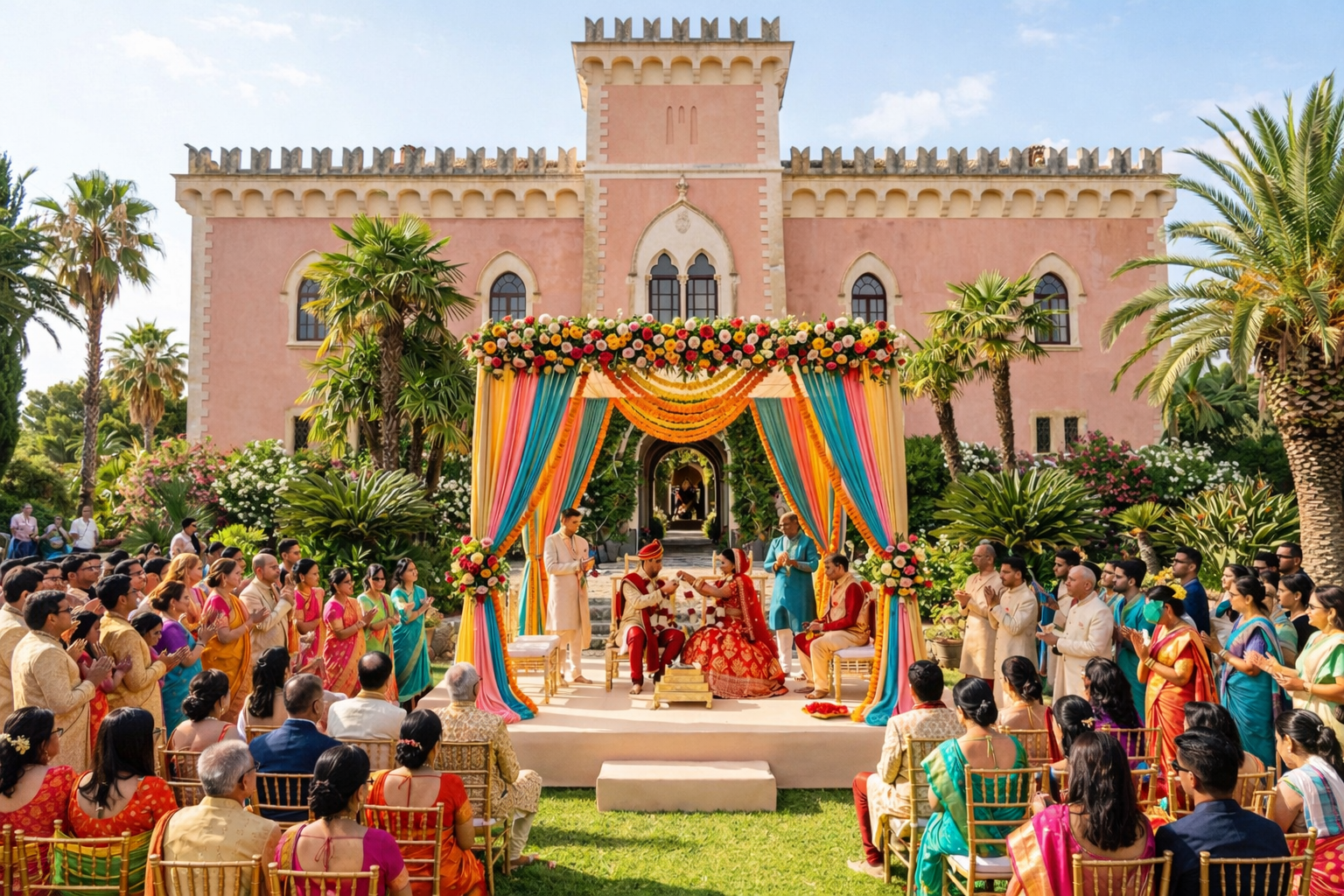
Documentary Film vs Cinematic Film
What Is a Documentary Wedding Film?
A documentary wedding film is built around one core principle: capture what happens, exactly as it happens.
The camera follows the day chronologically — getting ready, the ceremony, the cocktail hour, the speeches, the first dance, the reception. The edit preserves the natural timeline and the real sounds of the day: the vows as they were spoken, the laughter as it erupted, the music as it played.
The documentary approach is rooted in journalism and reportage. The videographer is an observer — present but unobtrusive, recording rather than interpreting. The result is a film that feels like a faithful, honest record of everything that took place.
Documentary films tend to work best for:
Couples who want to remember every detail of the day exactly as it happened
Weddings with a rich programme — long ceremonies, many speeches, lots of moments to preserve
Couples who value authenticity above all else and feel uncomfortable with anything that feels staged or directed
Families with guests who couldn't attend and want to feel like they were there
What Is a Cinematic Wedding Film?
A cinematic wedding film borrows its language from the world of film and television. It is not a record — it is a story.
The videographer approaches the wedding as a director approaches a short film: thinking about light, composition, movement, rhythm and emotional arc. The edit is non-linear — it doesn't follow the clock, it follows the feeling. Scenes are chosen not because they happened in order, but because they build towards something emotionally true.
Sound design, music selection and color grading are all used intentionally to create a specific atmosphere — one that captures not just what happened, but how it felt to be there.
A cinematic wedding film asks: what is the emotional truth of this story? And then it builds every frame around the answer.
Cinematic films tend to work best for:
Couples who want a film that feels like a piece of art, not a recording
Destination weddings where the location, light and atmosphere are central to the story
Couples planning a wedding in Sicily — where the visual richness of the island, the quality of the light and the character of the venues demand a cinematic approach
Couples who care deeply about aesthetics and want a film they will be proud to share
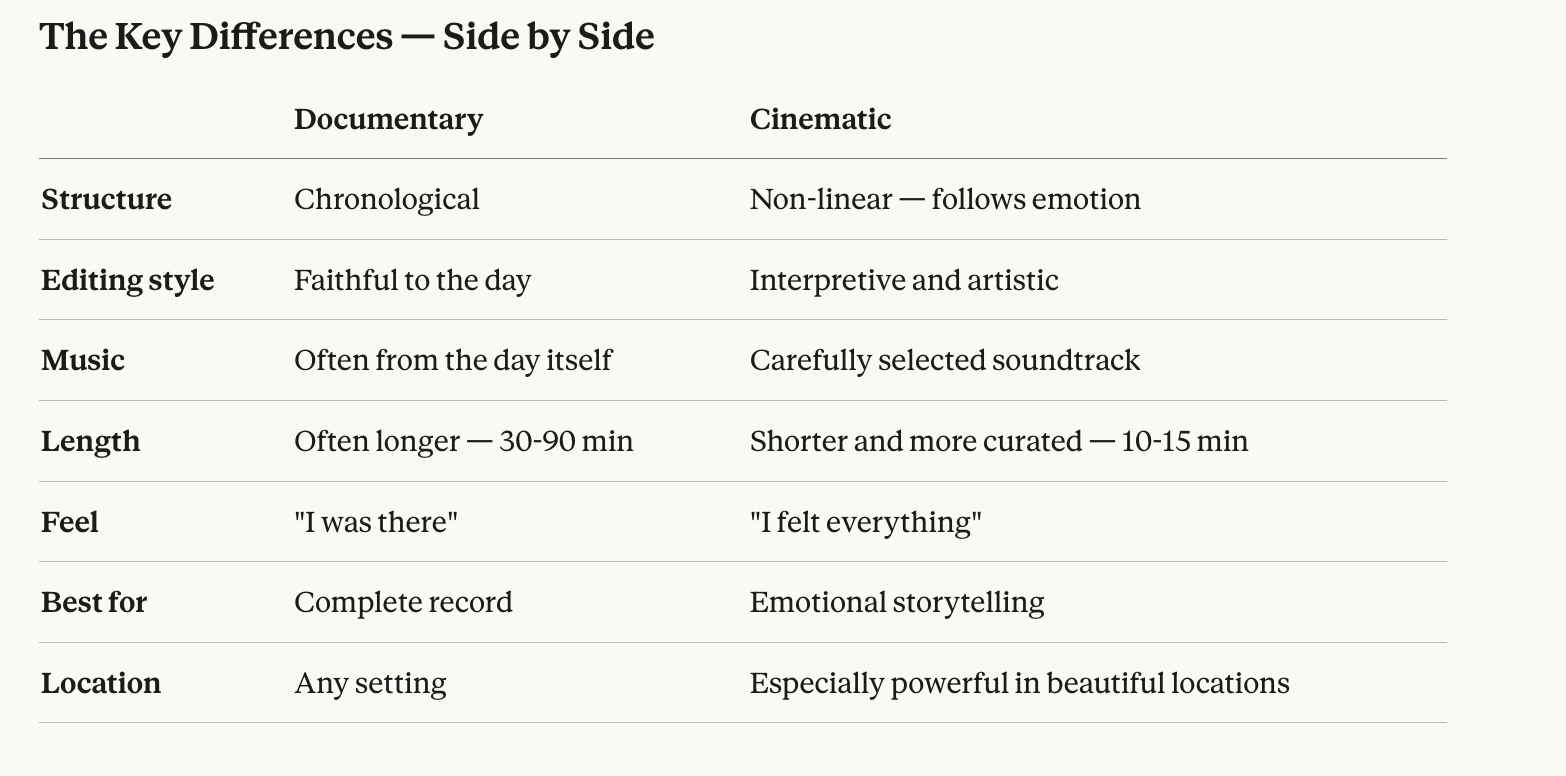
Why Most Modern Wedding Films Are Neither — and Both
Here is the truth that most videographers won't tell you upfront: the best wedding films today sit between the two styles.
Pure documentary can feel flat — a faithful record that lacks emotional shape. Pure cinematic can feel disconnected from reality — so edited and stylised that the real moments get lost beneath the aesthetics.
The most powerful approach combines documentary authenticity with cinematic technique. It captures real moments, unscripted and unposed, and then shapes them into something that has the emotional resonance of great cinema.
At Film Vision, this is exactly how we work. We are observers first — we never stage, direct or interrupt. But we bring to every wedding a cinematic eye: an instinct for light, composition and emotional truth that transforms what we observe into something that feels genuinely alive on screen.
The vows are real. The laughter is real. The tears are real. What we add is the craft to make sure all of it is seen, heard and felt the way it deserves to be.
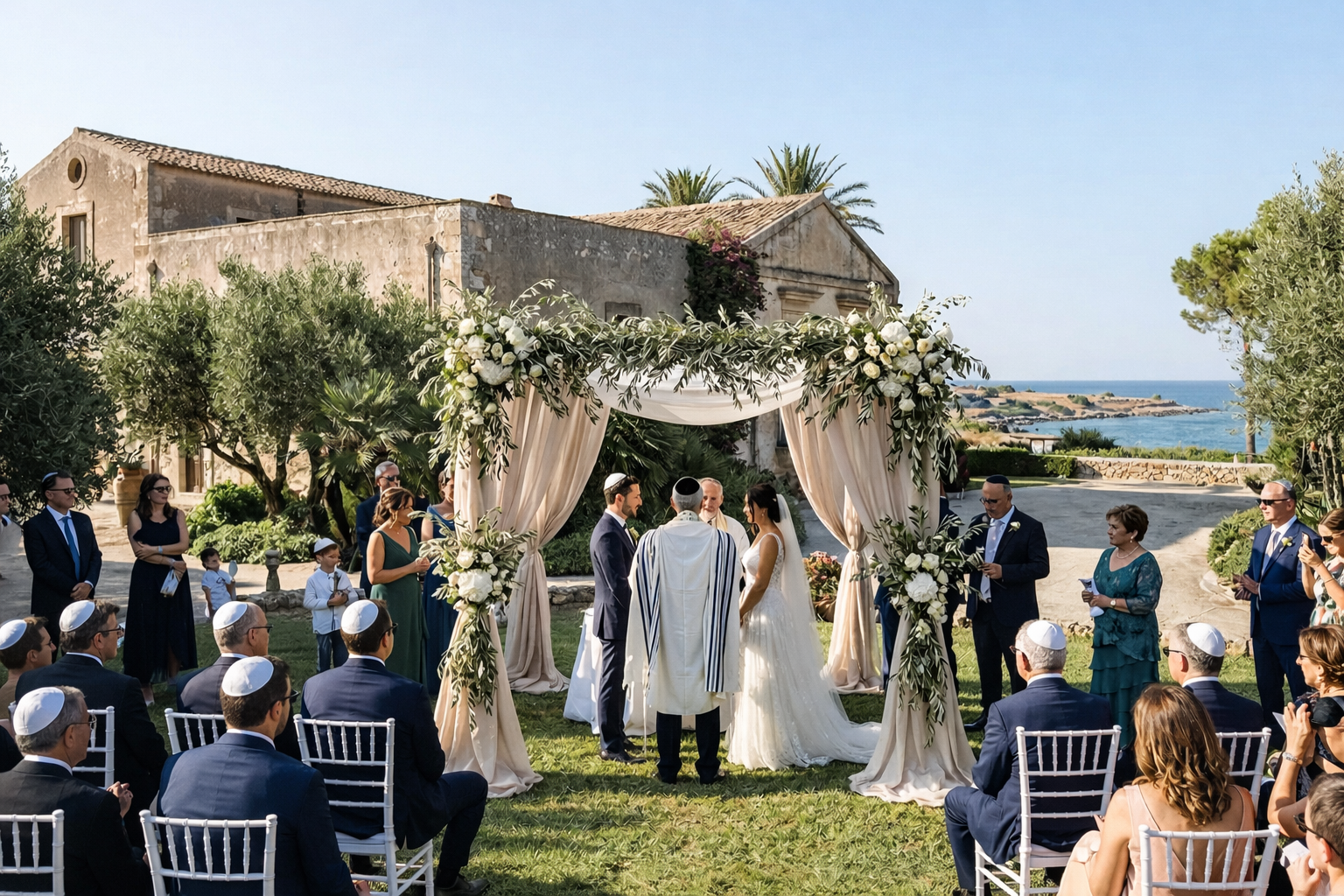
Which Style Is Right for Your Wedding in Sicily?
If you are planning a destination wedding in Sicily — particularly in locations like Taormina, Noto or Ragusa Ibla — the cinematic approach almost always produces the more powerful result.
Here is why.
Sicily is one of the most visually extraordinary places in the world. The light at golden hour in Taormina, the honey-gold stone of Noto's baroque streets, the dramatic landscapes of the Ragusa countryside — these are not just backdrops. They are active elements of your story.
A documentary approach records them. A cinematic approach uses them.
When a skilled cinematographer knows how to position themselves in the last light of a Sicilian evening, how to use the architecture of a baroque palazzo as a compositional element, how to let the sound of the Ionian Sea become part of the emotional texture of a scene — the result is something that no documentary approach alone could achieve.
That said, the choice ultimately comes down to what matters most to you. Ask yourself these questions:
When you imagine watching your wedding film in ten years, what do you want to feel?
If the answer is "I want to remember every moment exactly as it happened" → lean documentary
If the answer is "I want to feel the emotion of that day all over again" → lean cinematic
What do you value more in a film?
Completeness → documentary
Emotional intensity → cinematic
How do you feel about editing and music?
If you want the real sounds of the day to be preserved → documentary
If you want a carefully crafted soundtrack that amplifies the emotion → cinematic
Questions to Ask Your Wedding Videographer
Before booking any wedding videographer — in Sicily or anywhere — ask these questions to understand exactly which approach they use:
Can I watch a full wedding film, not just a highlight reel? A highlight reel can look cinematic even when the full film is purely documentary. Always ask to see a complete film.
How do you describe your editing style? Listen for specific language — does the videographer talk about "emotional arc", "non-linear storytelling", "light and composition"? Or do they talk about "complete coverage" and "every moment"? Both are valid — but they are different.
How do you handle the ceremony audio? In a documentary film, the ceremony audio is preserved in full. In a cinematic film, it is often woven into a music-led edit. Neither is wrong — but you need to know which approach will be used for your film.
What is your typical film length? Documentary films tend to be longer. Cinematic films tend to be shorter and more distilled. A full cinematic wedding film of 10-15 minutes represents hours of footage carefully shaped into something emotionally concentrated.
The Film Vision Approach
At Film Vision, we describe our work as documentary storytelling with cinematic aesthetics.
We arrive at every wedding with one intention: to disappear into the background and observe everything. We never ask couples to pose, never interrupt a moment, never direct a scene. What happens, happens — and we are there to catch it.
But we bring to every wedding a cinematic eye. We understand light, composition and emotional rhythm. We know how to use the landscapes of Sicily — the golden hour over the Ionian Sea, the baroque stone of Ragusa Ibla at dusk, the volcanic drama of Etna on the horizon — as active elements of your story rather than passive backgrounds.
The result is a film that feels real and cinematic at the same time. Authentic because nothing was staged. Beautiful because everything was seen.
If that is the kind of film you are looking for — for your destination wedding in Sicily or anywhere across Italy — we would love to tell your story.
Get In Touch · Watch Our Wedding Films · Explore The Sicily Edit