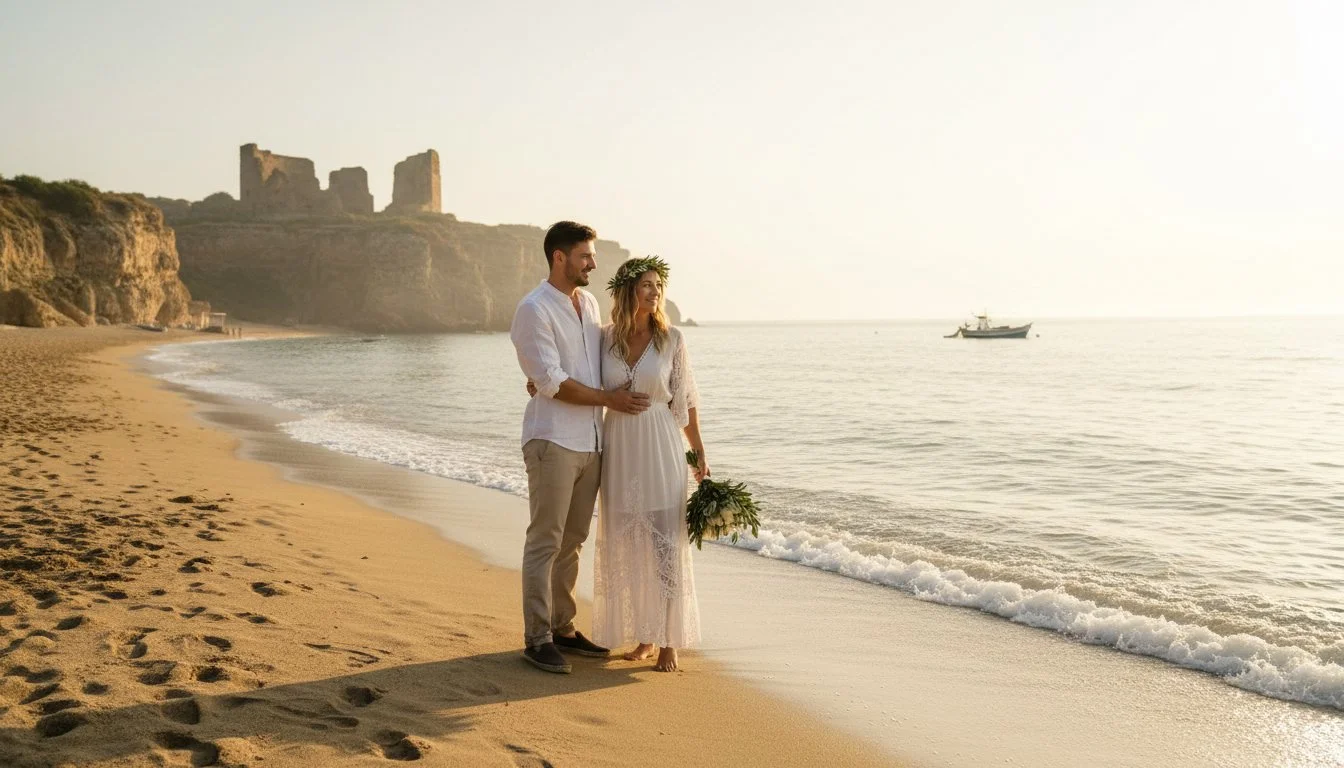
There is a moment in every wedding plan when some couples pause and ask themselves a question they did not expect: what if we just went?
No seating plans. No catering negotiations. No list of 150 guests, half of whom you see once a year. Just the two of you, and the most extraordinary island in the Mediterranean.
An elopement in Sicily is not a lesser version of a wedding. It is something else entirely: a more deliberate, more intimate and in many ways more powerful celebration of your love. And with its ancient landscapes, Baroque towns, volcanic drama and crystalline sea, Sicily is one of the most extraordinary places in the world to do it.
This guide covers everything you need to know: the best places on the island, the legal side, the ideal season, what a Sicilian elopement really costs, and how to capture the day on film so you can relive it for the rest of your lives.
What Is an Elopement, And Is It Right for You?
The modern elopement has moved far beyond its original meaning. Today it usually means one of three things.
- Just the two of you
- A completely private ceremony with no guests, only you and the professionals you choose: a celebrant, a videographer, a photographer. The elopement in its purest form.
- A micro-wedding
- A small celebration with 5 to 20 of your closest people: the atmosphere of an elopement with the people who matter most. More and more, the favourite format of international couples who want intimacy without leaving family out.
- A symbolic ceremony abroad
- A personal, non-legal ceremony in Sicily, with the legal paperwork done at home. The smoothest route for most international couples: no Italian bureaucracy, and you still have the ceremony, the place and the film.
If any of these sounds more like you than a 150-guest reception, you are in the right place.
Why Sicily Is Perfect for an Elopement
Sicily offers what most European elopement destinations cannot: extraordinary variety in a small area.
In a single day you can move from the volcanic drama of Etna to the golden Baroque streets of Ragusa Ibla, from the Greek ruins of Ortigia to an empty stretch of coast, from a candlelit palazzo in Taormina to the surreal white cliffs of the Scala dei Turchi. Each place tells a completely different story, and for an elopement that variety is everything: your film will not look like anyone else’s.
Sicily also has a quality that suits intimate celebrations: authenticity. The island has not been polished into a wedding-industry product. Its Baroque towns are genuinely old, genuinely lived in and genuinely Sicilian, its landscapes raw and unfiltered, its light extraordinary. For a film that feels like real cinema, shot in a place with real character, Sicily is hard to beat.
For the full picture of why couples from the US, the UK, Australia and beyond choose this island, read our complete guide to destination weddings in Sicily.
The Best Locations for an Elopement in Sicily
Ragusa Ibla
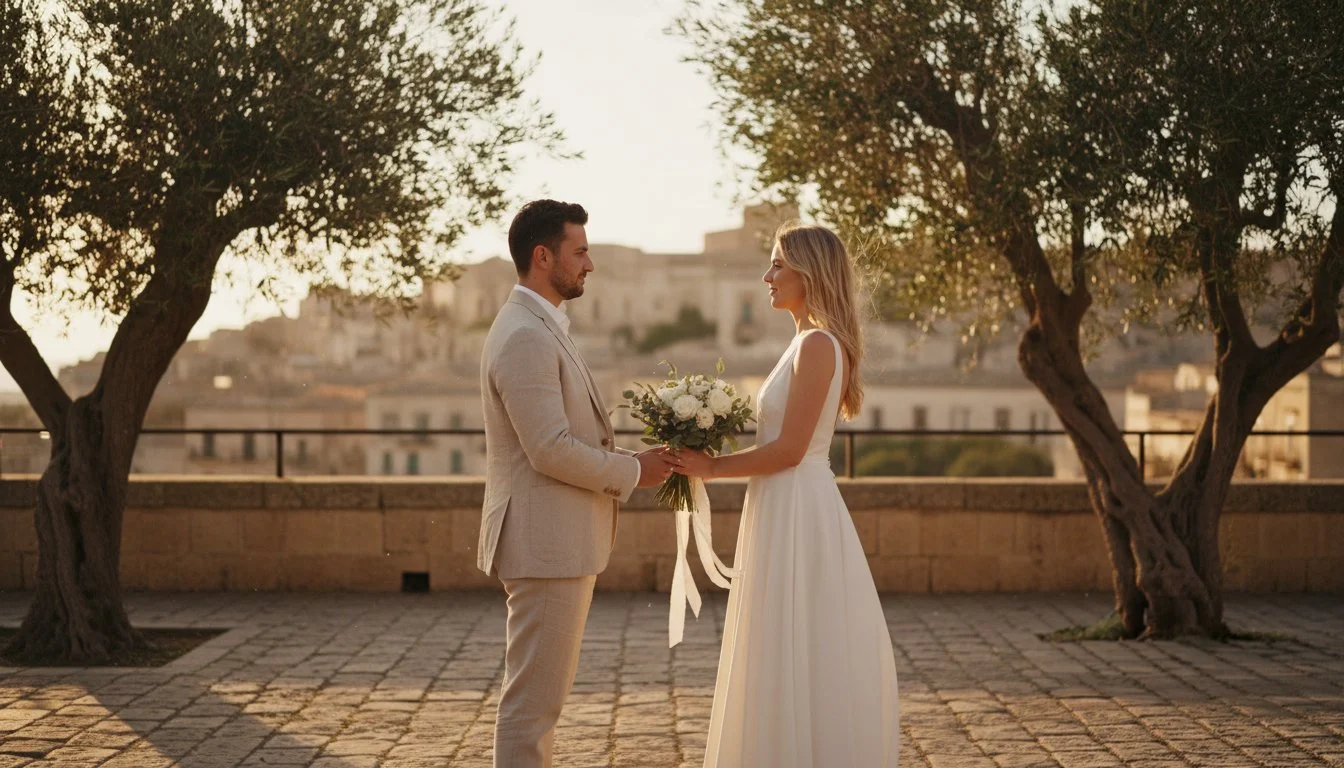
Ragusa Ibla is our most recommended elopement location in Sicily, for good reason. Its Baroque old town, built into the hillside of the Iblean plateau, packs extraordinary locations within walking distance of one another: the steps of the Duomo di San Giorgio, the panoramic terrace of the Giardino Ibleo at golden hour, the narrow alleys of the historic centre in the early light before the town wakes.
Ragusa is where Film Vision is based. We know every corner of Ibla, every hour of its light and every hidden angle; when couples ask where to elope in Sicily, this is almost always our first answer.
Ortigia, Syracuse
The ancient island heart of Syracuse is one of the most layered and cinematic places in Sicily: a maze of Baroque streets, Greek ruins, fountains and old palazzi surrounded by the Ionian Sea. An elopement here feels timeless. Piazza del Duomo at golden hour, the cathedral glowing gold and the square almost empty, is one of the most extraordinary ceremony settings in Europe, and the seafront at dawn, before the visitors arrive, is simply breathtaking. For history, depth and the feeling of standing inside something ancient, Ortigia is the answer.
Scala dei Turchi
One of the most visually dramatic landscapes in Sicily, and arguably in Italy: a natural staircase of brilliant white marl descending into a turquoise sea near Agrigento, on the southern coast. The contrast between white rock, deep blue water and sky, especially at golden hour, gives footage unlike anything else on the island: no architecture, no history, just the raw, surreal beauty of the coast. The rock itself is protected and access to it is restricted, so ceremonies and filming take place from the beach and viewpoints around it; your planner will know the current rules.
Mount Etna
An elopement on an active volcano. If that sentence speaks to you, you already know Etna is your place. Its lunar landscapes (black lava fields, craters, old flows frozen in time) create a visual language unlike anything else in Sicily or Europe, and the contrast between the raw volcano and the tenderness of two people choosing each other is one of the most powerful images we can imagine.
Etna works in every season: in summer the views stretch across the island, in winter the snow-capped summit stands against a clear sky. At altitude the light is different, sharper and cleaner than at sea level. The upper slopes are regulated and need guides and permits, which a local planner can arrange.
Taormina
Taormina needs little introduction, but for an elopement it offers what large weddings cannot: complete intimacy. The ancient Greek Theatre with Etna behind it, the terraces of the old town above Isola Bella, Corso Umberto in the early morning: for two people and a camera, the town is extraordinary. Eloping here also means staying in some of Sicily’s finest hotels, such as the Belmond Grand Hotel Timeo and San Domenico Palace, and experiencing the town in a way a large group simply cannot.
Savoca
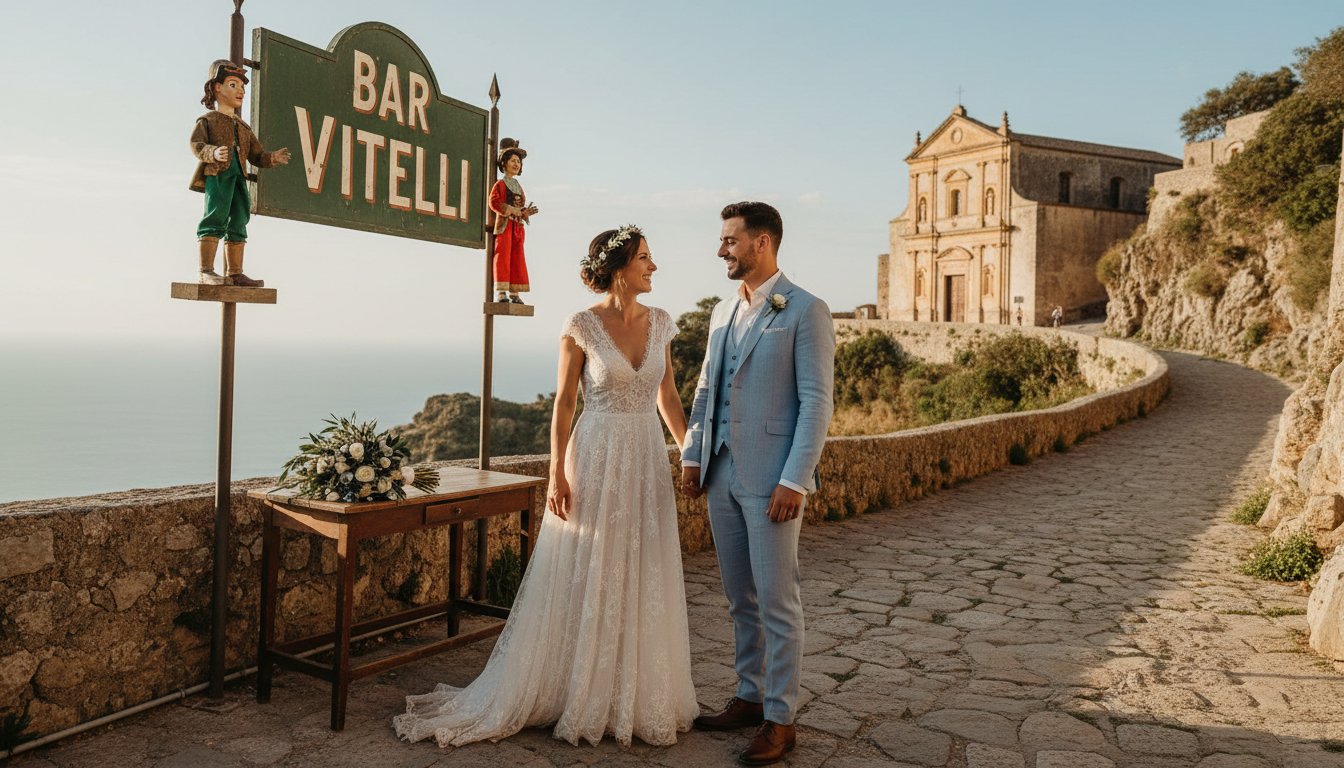
Some places in Sicily feel as if time has stopped, and Savoca is one of them. A medieval hilltop village above the Ionian coast near Messina, it is known worldwide as the place where Francis Ford Coppola filmed key scenes of The Godfather: Bar Vitelli, where Michael Corleone asks for Apollonia’s hand, and the Church of San Nicolò, where they marry.
Beyond its cinematic legacy, Savoca offers rare authenticity. The stone streets, the ruined castle, the old church and the views over the Ionian and the Strait of Messina have barely changed in centuries. For couples who love cinema, marrying in the village where one of the greatest films ever made was shot carries an undeniable power. San Nicolò is a sought-after church for Catholic weddings, symbolic ceremonies take place on the terraces of the village, and the terrace of Bar Vitelli, looking over the valley and the sea, is one of the most cinematic spots in Sicily. Savoca is about an hour from Catania airport and 30 minutes from Taormina, so it combines easily with a wider itinerary.
Cefalù
On the northern coast, Cefalù is one of the most romantic elopement settings on the island: a Norman cathedral above a medieval town, cobbled alleys that lead straight to a crystalline sea, and the silhouette of La Rocca over one of the most beautiful harbours in the Mediterranean. About an hour and ten minutes from Palermo airport, its Arab-Norman architecture and turquoise water have a look completely different from the Baroque south, and its cathedral, a UNESCO World Heritage Site, is one of the finest ceremony backdrops in Italy. It is ideal for the smallest elopements, and loveliest in late spring and early autumn.
The Aeolian Islands
For somewhere truly remote, the Aeolian Islands may offer the most extraordinary elopement in Sicily. Panarea, the smallest and most exclusive, is perfect for luxury and total privacy, with whitewashed terraces, bougainvillea and Strombolicchio on the horizon. Salina, green and lush, has vineyards running down to the sea and one of the most cinematic sunsets in the Mediterranean. Stromboli, with its constantly active volcano and eruptions at night, is for couples who want something unforgettable. The logistics need more planning than on the main island, but the films are in a category of their own.
Palermo
Palermo is not the first city that comes to mind for an elopement, and that is what makes it interesting. Sicily’s capital is a city of contrasts: Arab-Norman architecture, lively street markets, grand aristocratic palazzi and hidden courtyards that feel like secret gardens. For an urban, slightly alternative elopement, inside a living Sicilian city rather than a polished wedding destination, it has an atmosphere nowhere else on the island can match, from the Cappella Palatina and the cathedral of Monreale just outside the city to rooftop terraces over the bay. It is also one of the island’s two main gateways, with direct flights from across Europe.
Combining Multiple Locations: The Sicilian Elopement Itinerary
Without the logistics of a large group, an elopement gives you the freedom to move. Many of our favourite elopement films were shot across two or three places in a single day, turning the celebration into a small cinematic journey. A typical multi-location day might look like this:
- Dawn
- Ragusa Ibla, the town empty, golden light on the Baroque stone, a quiet walk through the alleys.
- Mid-morning
- The ceremony, on a terrace of the Giardino Ibleo or in a private courtyard of Ibla (for a Catholic wedding, at the Duomo di San Giorgio).
- Late morning
- A drive to the south-east coast, or to Modica for lunch together.
- Afternoon
- A second location: the salt pans near Marzamemi, the coast of Vendicari, or the countryside between Noto and Syracuse.
- Golden hour
- The place of your choice: the Ionian coast, an olive grove, a vineyard.
The compact south-east makes this kind of day genuinely feasible, and for couples who want the film to feel like a cinematic road trip, it is one of the most powerful formats we offer.
The Legal Side: How to Elope in Sicily
International couples have three options: a symbolic ceremony, a civil ceremony or a Catholic one. The two legal routes are explained in our guide to getting married in Sicily.
Symbolic ceremony. The simplest and most popular. It has no legal standing in Italy: it is a personal, emotional celebration led by a celebrant of your choice, in any language and any place, and the legal marriage is done at home, before or after. No Italian bureaucracy, no waiting periods, no restrictions on location.
Civil ceremony. A marriage legally recognised in Italy. It needs documents from your home country (usually a nulla osta or equivalent), a declaration of intent at the town hall a few days before, and coordination with the Italian municipality where you marry. It is entirely possible but takes planning: start the paperwork four to six months ahead, ideally with a local planner or legal coordinator.
For most international couples we recommend the symbolic route: complete freedom of place, language and format, without the administrative complexity. If you want the marriage recognised in Italy from day one, the civil route is achievable: start the conversation with your planner as early as you can.
The Best Season for an Elopement in Sicily
Every season has something to offer an elopement, but some suit intimate celebrations particularly well.
- October and November
- Our favourite months for elopement films: lower, warmer, more directional light, a quieter island and the iconic places free of crowds.
- April and May
- Lush landscapes, perfect temperatures and long golden evenings for outdoor ceremonies.
- December to February
- The most intimate season, especially in Ragusa Ibla and Ortigia, which take on a quiet, candlelit quality: remarkable for a truly private elopement.
- July and August
- Possible with careful planning: peak heat and crowds, but the longest golden evenings of the year. Dawn and evening ceremonies are the rule.
For a full breakdown, read The Best Season for a Destination Wedding in Sicily.
How Much Does a Sicily Elopement Cost?
One of the questions we hear most, and one of the hardest to answer with a single figure, because the range is wide. As a rough guide, excluding international travel and accommodation:
- Minimalist elopement
- The two of you, a symbolic celebrant, videographer and photographer, one or two locations and a simple dinner: from €4,000–€7,000.
- Classic elopement
- A full professional team, a refined dinner at a destination restaurant, flowers, more than one location, hair and make-up: typically €7,000–€15,000.
- Luxury elopement or micro-wedding
- Up to 20 guests, an exclusive-hire venue, full planning, a multi-location day and fine dining: €15,000–€40,000 or more.
Sicily is extraordinary value compared with Tuscany, the Amalfi Coast or Santorini, one reason it has become so popular with couples from the US and the UK.
What Does an Elopement Film Look Like?
An elopement film is usually shorter and more concentrated than a full wedding film, but no less powerful: without the structure of a full wedding day, every scene counts. It typically runs 3 to 5 minutes, long enough for the whole emotional arc of the day and short enough to stay immersive and rewatchable for years. A vertical reel for social media and a full-length cut of the ceremony and vows can be added as extras.
Without a large guest list, an elopement film is actually easier to make beautiful. We can focus entirely on two people: their gestures, their expressions, the way they look at each other, the landscape around them.
Still deciding on a style? Read documentary vs cinematic wedding films, and for choosing a videographer for your elopement, Booking a Wedding Videographer in Sicily.
Practical Tips: Planning Your Sicilian Elopement from Abroad
Arrive at least 48 hours before. Jet lag and Sicilian heat are not a good combination on camera. Give yourselves a day to adjust, see your location and settle into the rhythm of the island.
Consider a day-after session. Many couples do a more relaxed shoot the next morning, in different clothes and somewhere else, sometimes by the sea. It adds great variety to the film without the pressure of the ceremony day.
Hire a local planner, even for an elopement. A Sicily-based planner handles permits for dramatic locations such as Etna, the Scala dei Turchi and some heritage sites, transport, the celebrant and all the small logistics that would otherwise fall on you.
Plan the travel between places. If you are combining Ortigia, Noto and Ragusa in one day, or Taormina with Savoca and Etna, work out the timings with your planner: Sicilian roads are beautiful but slower than they look on the map.
Planning from the US? How to Plan a Wedding in Sicily from the US covers timelines, documents and logistics in full.
Frequently Asked Questions
Can we legally get married in Sicily as international couples?
Yes. Civil ceremonies are available to international couples in Italy, though the documents required vary by nationality. Many couples prefer a symbolic ceremony in Sicily with the legal ceremony at home: it is simpler, faster and places no restriction on location.
How many days should we plan for a Sicily elopement?
At least four to five days including travel, ideally seven to ten: time to adjust, enjoy the island, have the ceremony day without rushing and add a day-after session. Many couples combine the elopement with a slow honeymoon across the island.
Do we need a wedding planner for an elopement?
For a pure two-person elopement with a symbolic ceremony, strictly speaking no. But a local planner makes everything much smoother, especially for location permits, the celebrant and transport, and for micro-weddings with guests a planner is effectively essential.
How far in advance should we book?
For May, June, September and October, nine to twelve months ahead is strongly recommended. For off-season elopements in November, December or February, four to six months is usually enough. The most in-demand videographers, photographers and planners fill their calendars early in any season.
Can an elopement film include vows in two languages?
Absolutely, and it often makes the film more beautiful. Many couples speak their vows in English with a few lines in Italian or another language that matters to them, and the film weaves both together.
Is Sicily safe for an elopement?
Yes. Sicily is a safe region for international travellers, with warm, welcoming local communities and well-developed tourism infrastructure in every area covered in this guide.
Film Your Elopement in Sicily with Film Vision
At Film Vision we bring to elopements the same cinematic intention as to every wedding, and often even more creative freedom. Without a fixed timeline or a large group, we can follow the light, move through a place at the pace the story needs and wait for the moment instead of rushing to the next one. The films that result are often among the most emotionally concentrated work we make.
We are based in Ragusa, in the heart of the south-east, within easy reach of Ragusa Ibla, Ortigia and the Val di Noto, and about two hours from the Scala dei Turchi, and we film across the whole island: from Taormina and Savoca on the Ionian coast to Cefalù and Palermo in the north, and out to the Aeolian Islands when the story calls for somewhere truly remote.
Planning an elopement in Sicily?
If you want a cinematic film that tells your story with the depth and beauty it deserves, we would love to hear from you.
Get in touch