What Ruins a Sicily Wedding Video (And How to Avoid It)
You spent months choosing the right venue in Ragusa Ibla. You flew to Sicily to visit the masseria. You researched every detail of your ceremony. And then, looking back at your wedding video a year later, something feels off — beautiful images, but not quite yours.
This happens more often than couples expect. And in most cases, the mistakes that compromise a Sicily wedding video have nothing to do with the videographer's technical skill. They happen before the camera ever starts rolling — in the planning phase, in decisions that seem unrelated to video, in assumptions about how the day will unfold.
Here is what actually gets in the way of a great wedding film in Sicily, and what to do differently.
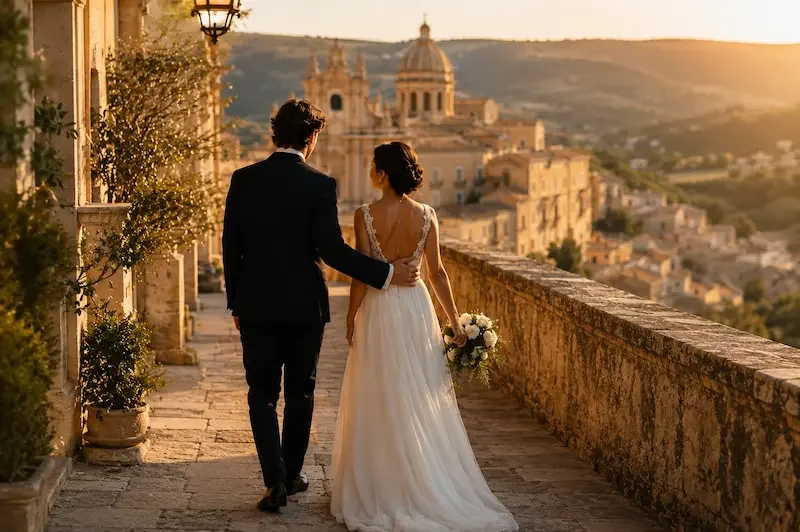
1. Booking a Videographer Without Considering Local Knowledge
Sicily is not a generic Italian backdrop. The light in the Val di Noto in July is completely different from what you would find on Lake Como or in Tuscany. The summer sun at midday is brutal and flat. The golden hour in August lasts less than thirty minutes. Filming inside a baroque church in Noto requires knowledge of how that specific interior handles available light — because flash is rarely an option and tripods are often prohibited.
A videographer who has filmed extensively in Sicily brings something no amount of preparation can replicate: familiarity with the territory. They know which courtyard of which palazzo goes into shadow at 5 pm. They know the permit requirements for filming in a UNESCO historic centre like Ragusa Ibla or Siracusa. They know which local suppliers — florists, planners, ceremony coordinators — understand how to collaborate with a video crew without friction.
When you book a videographer who is travelling to Sicily for the first time, you absorb all the risk of that learning curve. When you work with someone who already knows the territory, that knowledge becomes part of your film.
2. Losing the Golden Hour to the Schedule
In Sicily, golden hour is not just a nice bonus. It is often the visual centrepiece of an entire wedding film. The warm, low Mediterranean light that arrives in the hour before sunset transforms every location — the carved stone facades of Noto, the dry stone walls of the countryside, the sea view from Taormina — into something genuinely cinematic.
And it lasts, on average, 25 to 40 minutes.
The most common mistake is treating that window as flexible. It is not. The sun does not negotiate with the catering timeline. When the golden hour arrives, the couple needs to be present — not stuck at the table between the first and second course, not caught in a transition between the church and the reception venue.
A generous timeline is one of the most underrated tools in wedding videography. Building in buffer time — fifteen minutes here, twenty minutes there — is what allows your videographer to capture the moments that look effortless on screen but require space to happen. The spontaneous glance, the quiet moment before entering the reception, the laughter that no one planned for.
Plan the schedule with your videographer before finalising it. They know exactly when and where the light will be best for your specific venue and date.
3. Choosing the Venue From a Photo
Every wedding venue in Sicily looks extraordinary in a well-composed photograph. The baroque courtyard, the terrace overlooking the valley, the masseria with its ancient almond trees — the images are real, but they are frozen moments that tell nothing about how the space actually behaves over time.
A venue has a morning light and an afternoon light that can be almost opposite. It has interior corridors that compress badly on video. It has an outdoor ceremony area that is in direct sunlight at 11 am — uncomfortable for guests, difficult for cameras. It has acoustics that will either preserve or destroy the recorded audio of your vows.
These are things a photograph cannot show. When you are planning a destination wedding in Sicily from abroad, ask your videographer to review the venue with you before you sign the contract. If they have already filmed there, even better — they will have direct knowledge of what works, what does not, and how to make the most of the space.
The visual narrative of a wedding film is shaped as much by the location as by the direction itself. Knowing the venue in depth is part of making a great film.
4. Underestimating the Role of Visual Coherence
The floral design, the table settings, the colour palette of the decorations — these elements are often planned entirely separately from any conversation about video. That is a missed opportunity.
What gives a wedding film a cinematic quality is not a single dramatic shot. It is the visual coherence that runs through the entire film: flowers, fabrics, colours, and architecture all speaking the same language, frame after frame.
In Sicily this is particularly relevant because the landscape and the local aesthetic already provide a strong visual identity — the warm ochre of the stone, the deep greens and whites of the gardens, the texture of hand-painted ceramics. When the floral design and decoration choices are aligned with that identity rather than working against it, the video gains a cohesion that post-production alone cannot manufacture.
Talk to your videographer and your planner at the same time. Even a short conversation about the overall aesthetic direction of the day — colours, atmosphere, references — can make a visible difference in the final film.
5. Skipping the Pre-Wedding Briefing
Most couples arrive at their first call with a videographer thinking they know what they want: something emotional, elegant, authentic. These are starting points, not a brief.
The difference between a generic wedding video and a film that actually feels like you almost always comes down to what was communicated before the day of filming. Not forms filled out, not a shot list — but real conversations about who you are as a couple, what the day means to you, which details carry weight that no guest would understand.
The song that plays at a specific moment because of a private memory. The way she laughs when she is completely at ease. The detail on the dress that took six months to find. The relationship with a parent that will make a particular moment in the ceremony the emotional core of the entire film.
A videographer cannot capture what they do not know to look for. The briefing is where that knowledge gets built. At Film Vision, this is a structured part of the process — a conversation that happens well before the wedding day, designed to make sure that when the moment arrives, the camera is already pointed in the right direction.
6. Arriving at the Day Tense
This one is harder to plan for, but it matters more than almost anything else.
Anxiety on a wedding day is completely understandable. But it leaves visible traces that no edit can fully erase: forced laughter, eyes scanning the room instead of connecting, a body that is physically present but emotionally somewhere else. The camera reads all of it.
The couples whose wedding films are truly beautiful are almost always the ones who managed to let go — not of care or intention, but of the need to control every moment. They trusted their team, they trusted the plan, and they allowed themselves to actually be inside the experience rather than observing it from a slight distance.
A good videographer in Sicily will work to ease that tension from the first minutes of the day. But there is a limit to what any outside perspective can do. The emotional impact of a wedding film depends, more than anything else, on two people choosing to be present rather than perfect.
7. Treating the Video as Secondary Until It Is Too Late
Wedding videography tends to sit near the bottom of the planning list. It gets dealt with after the venue, the catering, the photographer, the dress, the flowers, and the entertainment. By the time many couples get to it, the calendars of the most experienced local videographers are already full — especially for the peak Sicily wedding season between April and October.
Rushing the choice compresses everything that makes the process work: the time to review their full films (not just highlights), the conversations to build a shared vision, the space to ask the questions that matter. A videographer who truly knows the people they are filming brings a level of awareness to the set that a last-minute briefing cannot replicate.
Book early. Have the conversation properly. A quality Sicily wedding film is not something that can be assembled in a hurry — it is built over months, starting the moment you first speak to the person who will tell your story.
Planning a Wedding in Sicily?
If you are considering Film Vision for your wedding in Sicily, the conversation starts here. We work with a limited number of couples each season — enough to give every wedding the time and attention it deserves.
Film Vision is a luxury wedding videography studio based in Ragusa, Sicily. We film destination weddings across the island, from the baroque Val di Noto to Taormina, the Aeolian Islands, and beyond.