Wedding Content Creator vs Videographer: What You Are Really Buying
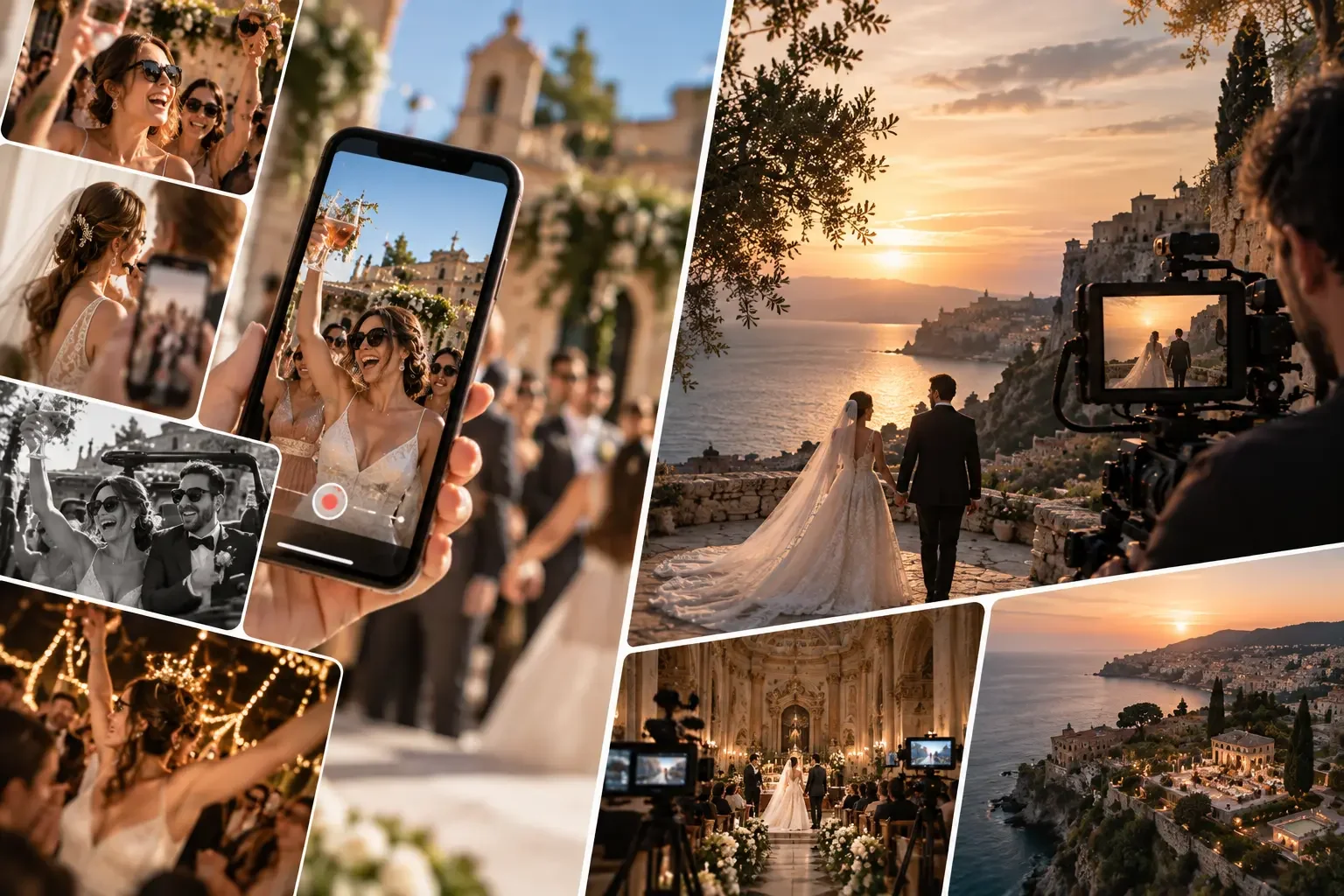
Somewhere in the planning, a proposal arrives with a line item you did not expect: content creator. It sits near the photographer and the videographer, it costs less than both, and nobody explains what it is. The question that follows is always the same one couples write to me: is this instead of you, or as well as you?
It is as well. And I want to explain why without pretending to be neutral, because I am not — I film weddings in Sicily for a living, and I have an obvious interest in the answer. So here is the honest version, the one I give couples at my kitchen table in Ragusa when they ask me directly.
A wedding content creator and a wedding videographer are not two tiers of the same service. They are two different jobs that happen to involve a camera, in the same way that a sommelier and a vineyard owner both work with wine. Confusing them is easy, the industry does nothing to make it clearer, and the cost of the confusion is only visible a year later.
The mistake is almost never choosing a content creator. It is believing you have bought a film.
This guide covers what each one actually delivers, what changes when the wedding is in Sicily rather than at home, how to run both on the same day without collisions, and the questions that reveal what you are really buying.
What a Content Creator Actually Does
A content creator works for the next forty-eight hours of your life.
They shoot vertical, usually on a phone, and the whole discipline is built around speed. While you are still having your hair done, they are already cutting. By the time the aperitivo starts, there is a sequence ready to post. The morning after, before you have unpacked anything, you have a folder of clips you can put online yourself.
That immediacy is a real product, and I want to be clear that I do not think it is a lesser one. It answers a question that genuinely matters to people: how do I share this now, while everyone still cares?
What you receive
Vertical clips and reels, typically within a day or two. Raw phone footage you can repost yourself. Candid moments — guests reacting, the mess behind the scenes, the texture that performs well on social precisely because it looks unproduced. Some will also run your stories live through the day.
What is not part of the job
Separately recorded audio. Multiple cameras on the ceremony. Colour grading. A narrative structure. None of this is a shortcoming — it is simply outside the brief. Asking a content creator to deliver a film is like asking a journalist to write a novel because both involve sentences.
What a Videographer Does
A videographer works for the fortieth anniversary.
That sounds like a line, but it is the actual design brief. Everything in the way I work is arranged around a single assumption: that one day someone will sit down and want to hear the vows again, in full, without a song playing over them.
Most of what separates the two jobs is invisible on the day itself. Couples watching me work see a camera, and content creators have cameras too. The difference is in five things nobody photographs.
Sound
Lapel microphones on both partners and the celebrant, a feed from the sound desk, a backup recorder running independently. A phone three rows back records a baroque church doing what baroque churches do to the human voice: turning it into reverb. Ten years from now, it is the words you will want, and the words are the first thing to be lost.
Angles
The ceremony happens once. Two or three cameras in planned positions mean the moment you first see each other exists from your side, from theirs, and from the room. Nobody can be asked to walk down the aisle a second time.
Light
Sicilian venues are beautiful and technically brutal: a July ceremony in direct sun at four in the afternoon, a dinner in a baroque courtyard that slides from golden hour to candlelight in ninety minutes. Cinema sensors and proper glass hold both ends of that range. A phone chooses the sky and gives up the faces.
The edit
This is where most of the value sits, and it is entirely invisible on the wedding day. A film is not a sequence of good shots — it is a structure, built from hours of material, with the speeches placed where they land hardest and every frame colour graded. I spend considerably longer editing a wedding than I spend shooting it.
Redundancy
Dual card slots, footage copied to two drives before I leave the venue, archived for years afterwards. There is exactly one unforgivable failure in this profession, and every habit in a professional workflow exists to prevent it.
There is a sixth, harder to name: format. A 9:16 clip is built for the screen in your hand in 2026. A film is built for whatever screen exists in 2066.
Two Different Horizons
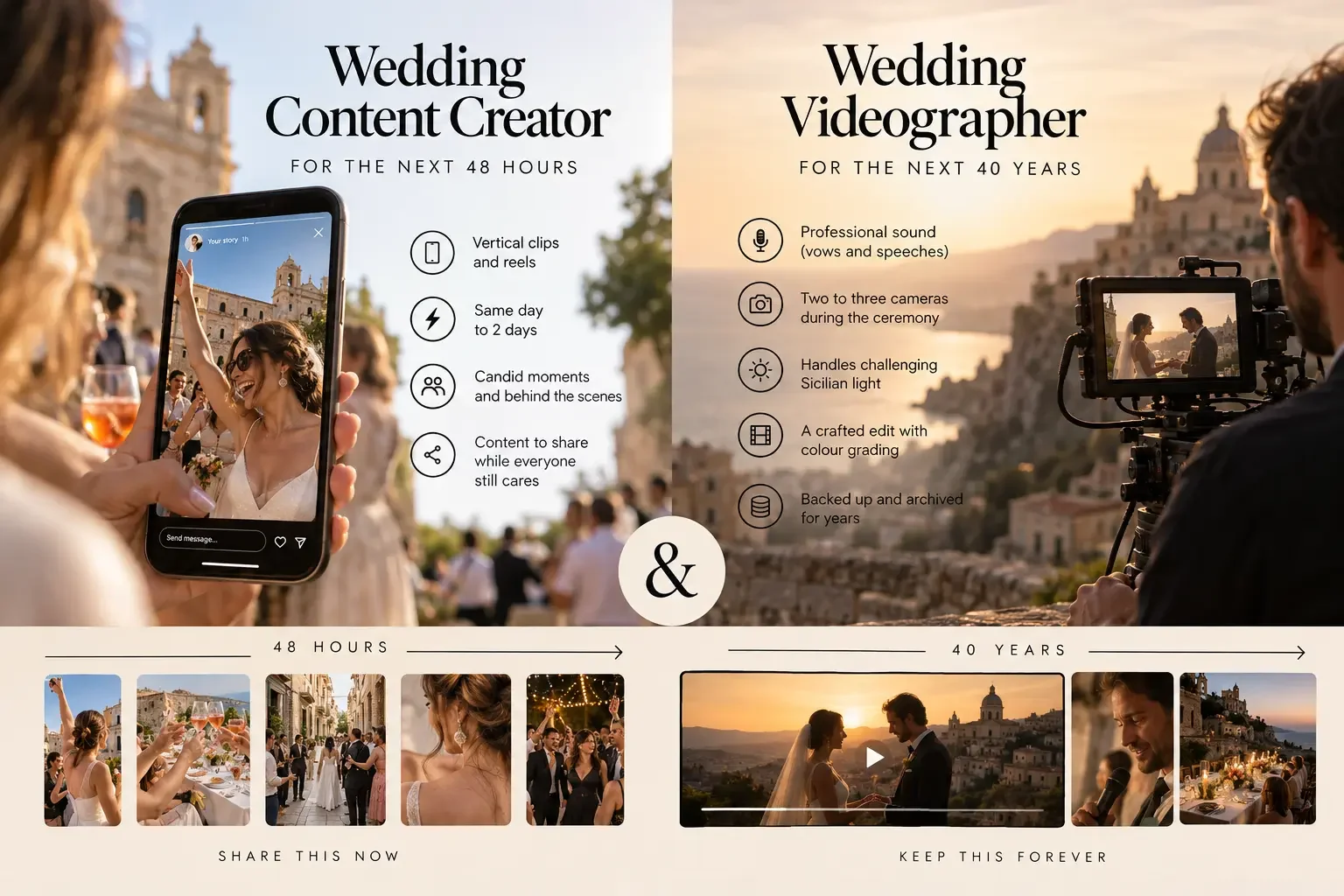
The clearest way to hold these apart is not by equipment or by price. It is by the span of time each one is built to survive.
Content creator
Forty-eight hours
Videographer
Forty years
Neither column is the better one. They are priced differently because they are not the same work, not because one is a discount version of the other.
The failure mode is specific, and I have watched it happen. A couple books only social coverage, has a wonderful time, posts beautifully. Then a year passes. Someone asks to see the vows — a parent, usually — and what exists is eleven seconds of the two of them with a song over the top. Nobody did anything wrong. The couple simply bought forty-eight hours thinking they had bought forty years.
Why Sicily Widens the Gap
Nearly everything written about this question assumes a wedding at home: one venue, one room, predictable light, few rules. A destination wedding here is a different job, and the difference tends to stretch the distance between the two roles rather than close it.
The day moves
A Sicilian wedding rarely stays in one place. Getting ready at a hotel in Ortigia, a ceremony in a baroque cathedral in the historic centre, aperitivo at a villa twenty minutes inland, dinner in a different courtyard again. A crew with a plan and two cars covers all of it. One person travelling alone is permanently arriving as something ends.
Churches have rules, and they are not the same rules
Many Sicilian parishes restrict where you may stand, whether you may move during the rite, and whether anything may fly near the building. These are decided locally, which means the parish in Modica and the parish in Noto will tell you different things. Someone who has filmed there has already had that conversation with the sacristan. The alternative is discovering the restrictions ten minutes before the bride arrives.
Light that changes faster than you expect
The island's best hours are also its hardest. A ceremony at four in July is hard, direct sun. A courtyard dinner in September drops from gold to candlelight inside an hour and a half. The sea throws light back up into faces from below. This exact range is where proper cameras and lenses stop being a vanity and start being the reason the faces are still visible.
Two languages, sometimes three
Bilingual ceremonies are the norm here, not the exception: an Italian celebrant, readings in English, a speech delivered twice. If those words matter — and they are usually the whole reason people cry — they have to be recorded properly rather than captured as the echo of a stone nave.
Flying is a licensed activity
The reason many couples choose Sicily is only visible from above: the shape of a coastline, a road lined with dry-stone walls, a town stacked against a hillside. Aerial work here requires ENAC-certified operators, insurance, and specific authorisations near airports and protected sites. It is not something improvised on the day.
None of this makes a content creator less useful in Sicily. It means the part of the day that needs a film crew is larger here, and less forgiving.
Running Both on the Same Day
Increasingly the honest answer is that you do not have to choose between two separate people. Most film studios, mine included, now deliver a short vertical cut within a day or two alongside the main film, made from the same professional footage. You get the immediacy without adding another body to the day, and the social clips do not look as though they came from a different wedding than the film.
A dedicated content creator still earns their place in three situations. If you want stories posted live throughout the day, as it happens. If you have a following or a brand and social output is a genuine priority rather than a pleasant extra. Or if you want a large volume of raw, candid phone footage to draw on for weeks afterwards.
If that is you, book both — and make them speak to each other before the day. This is the part nobody mentions, and it is the part that actually goes wrong.
How to keep them out of each other's way
Introduce them by email a month out, not on the morning. Agree who holds the aisle during the ceremony and who takes the side — two people improvising in the same three metres will end up in each other's frames, and only one of those frames is unrepeatable. Agree that the content creator does not stand in front of the locked-off camera during the vows. Decide in advance who gets the first fifteen minutes of golden hour with you, because both will want it and there is not enough of it for two. Done properly, nobody notices either of them. Done badly, the ceremony becomes a quiet territorial dispute happening a metre from your face.
Six Questions That Reveal What You Are Buying
Ask these of anyone, whichever role they describe themselves as. The answers sort it out faster than any portfolio.
- How do you record the vows and the speeches?If the answer involves microphones placed on people, you are speaking to a videographer. If it is "on the camera", you are not.
- How many people are working, and how many cameras run during the ceremony?One person cannot cover a ceremony from two angles, however good they are.
- What exactly do I receive, in what format, and when?Ask for a complete sample delivery, not a showreel.
- Can I watch a full film, start to finish?Trailers are built to conceal weak material. A whole film cannot.
- What happens to the footage afterwards?Backups, how long it is archived, whether you can request another edit in five years.
- Have you worked at my venue, or somewhere like it?In Sicily this is not small talk — it is the difference between knowing the restrictions and discovering them.
Where I Stand
I think a wedding deserves a film. Not because reels are worthless — they are not, and I make them too — but because a wedding is one of the very few genuinely unrepeatable days in a life, and the vows, the speeches, and your partner's face when they first see you are worth more than the attention span of a feed.
If social content is what you want and you are at peace with not having a film, then book a content creator and do it without guilt. Weddings carry enough obligations without inventing new ones.
But if you want the whole arc of the day kept — the words included — that is a different job, and no content creator can be substituted into it, however good they are. Get the immediacy as well as the thing that lasts, rather than instead of it.
Questions Couples Ask
Is a wedding content creator the same as a videographer?
No. A content creator produces short vertical clips for social media, usually delivered within a day or two, shot on a phone or compact camera. A videographer produces a fully edited film with separately recorded audio and multiple cameras on the ceremony. They are different services with different time horizons, not two price tiers of the same thing.
Can a content creator replace a wedding videographer?
Only if you do not want a wedding film. A content creator's product is social content. It will not contain your vows or the speeches in full, because recording those properly requires microphones and a workflow that sits outside the role.
Do I need both for a wedding in Sicily?
Not necessarily. Many film studios, including Film Vision, deliver a short vertical social cut within a day or two alongside the main film, made from the same professional footage. A separate content creator makes sense if you want stories posted live throughout the day, or a large volume of raw candid footage to use over the following weeks.
How much does a content creator cost compared to a videographer in Sicily?
Content creators generally cost less, because the scope, the equipment, the crew size and the editing time are all smaller. The two are not really priced against each other, since they are not the same service. For the videography side, costs in Sicily typically range from around €2,500 to €6,000 or more depending on coverage, crew and deliverables.
Can a content creator and a videographer work at the same wedding?
Yes, and it works well when they are introduced before the day rather than on it. Agree who holds the aisle during the ceremony, keep the content creator clear of the locked-off camera during the vows, and split golden hour deliberately. Handled that way, neither gets into the other's frames.
What should I ask before booking either one?
How they record the vows and speeches, how many people and cameras are working on the day, exactly what you receive and when, whether you can watch a complete film rather than a trailer, how the footage is backed up and archived, and whether they have worked at your venue before.
Planning a wedding in Sicily?
Tell me about your day and I will tell you honestly what it needs — including when that is less than you were about to book.
Get in touch