Wedding Videographer in Modica
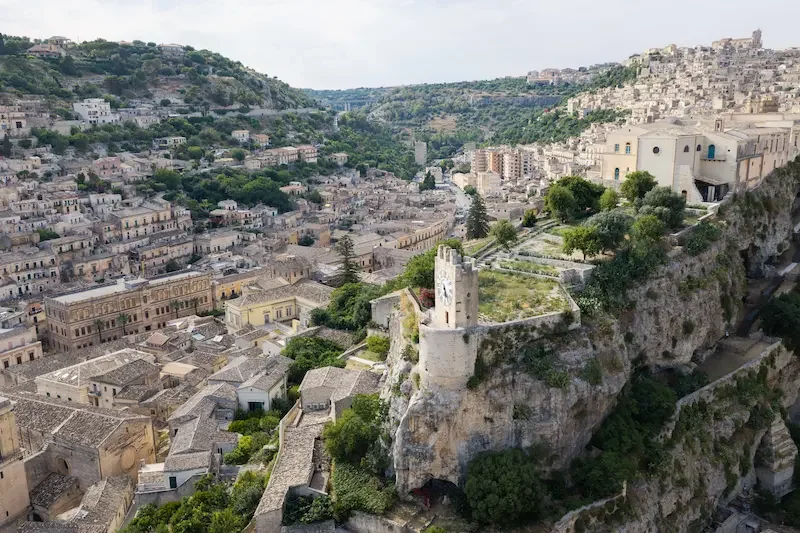
A Baroque town built inside a ravine, some two hundred and fifty steps beneath a cathedral, and a coastline of dunes fifteen minutes away, filmed by a videographer who lives twenty minutes from it.
Modica does not reveal itself gradually. You come over the ridge from Ragusa, the road drops, and the whole town appears at once below you: a Baroque city poured into a gorge, houses stacked up both slopes, church domes rising from the middle, and the great limestone façade of San Giorgio suspended above a staircase that climbs the hillside like a piece of theatre. There are more famous wedding destinations in Sicily. There is none that makes a stronger first frame.
We film in Modica constantly. It is twenty minutes from our base in Ragusa and fifteen from Scicli, in the heart of the territory where Film Vision was born, so we know its light hour by hour, its staircases step by step, and the exact minute in the late afternoon when the sun clears the ridge of Modica Alta and turns the eastern slope of the town gold. When we filmed Enrico & Elena’s wedding on the coast below the town, at Maganuco, the film moved from the Baroque centre to the dunes in twenty minutes of driving. That range, inside a single day, is what Modica offers and almost nowhere else does.
This guide covers what a destination wedding in Modica really looks like: where you can marry, where you can celebrate, what the town does to a film, and the practical details (flights, seasons, guests) that couples from the US, the UK and Australia ask us about first.
A City Built Inside a Ravine
Modica is one of the eight late Baroque towns of the Val di Noto inscribed together on the UNESCO World Heritage List, rebuilt, like Noto, Ragusa and Scicli, after the earthquake of 1693. But where Noto was laid out as a planned city on open ground, Modica had no open ground. It was rebuilt where it had always stood: inside a deep gorge where two rivers met, climbing both walls of the valley in terraces.
The rivers are gone, covered over after the disastrous flood of 1902, and their bed is now Corso Umberto I, the long, palazzo-lined avenue along the valley floor. Everything else in Modica rises above it. The town divides into Modica Bassa, along the corso, and Modica Alta, on the ridge, joined by an extraordinary network of stairways cut between the houses. Walking Modica means walking vertically. So does filming it.
The stone is part of the identity. Alongside the pale limestone of the Iblei, Modica uses pietra pece, a black bituminous limestone quarried locally, dark as slate, which appears in doorframes, church steps and paving all over town. On film it gives the Baroque a graphic weight, black against gold, with unusual contrast, especially in the low sun of late afternoon.
Modica has to be filmed in three dimensions. Everywhere else in the Val di Noto you frame across. Here you frame up and down.
And then there is the chocolate. Modica’s cold-worked chocolate, made without conching so that the sugar crystals stay whole and the texture stays granular, descends from a technique that reached Sicily through the Spanish and, before them, from Mesoamerica. It received PGI protection in 2018, and it is the reason many of your guests will have heard of the town before you mention it. Antica Dolceria Bonajuto, opened in 1880 on Corso Umberto, is considered the oldest chocolate maker in Sicily and is still run by the same family. Couples ask us about wedding favours all the time: in Modica the answer is obvious, local, and survives the flight home in any climate.
San Giorgio, San Pietro and the Great Staircases
Modica has two cathedrals, which tells you how seriously the town took its own rivalries. Both are among the finest Baroque churches in Sicily, and both are approached the same way: by climbing.
Duomo di San Giorgio — the staircase of 250 steps
San Giorgio is the great set piece of Modica, attributed to Rosario Gagliardi, the architect who defined the Baroque of the Val di Noto. The façade rises in three tiers to a bell tower, curved and theatrical, with five portals across the base, and it stands at the top of a monumental staircase of roughly two hundred and fifty steps that climbs the hillside in flights and terraces between the roofs of the lower town.
For a wedding film it is the strongest architectural sequence in south-eastern Sicily. The bride’s arrival is a climb. The exit is a descent, with the whole town spread out below the couple, guests scattered down the flights, rice and light, and the terraces of Modica Bassa falling away toward the corso. Very few churches in Italy give you an exit shot with that much depth already built in. We film it long, wide and from above where the light allows, and we never rush it.
Duomo di San Pietro — the twelve apostles
Down on Corso Umberto, San Pietro answers San Giorgio with a staircase of its own: a broad flight lined on both sides with life-size stone statues of the twelve apostles, leading to a wide Baroque façade. On film it is a completely different proposition (more open, more frontal, more classical) and much easier for guests with limited mobility, since it sits at the level of the corso rather than halfway up a hillside.
The interior is vast and luminous, with three naves and columns running the full length of the church, which gives a videographer room to work discreetly without crossing the aisle. For the grandeur of a Modican cathedral without the climb, San Pietro is the answer, and the apostles form an aisle of their own for the exit.
Santa Maria di Betlem and the Cappella Palatina
Behind a modest exterior in Modica Bassa, Santa Maria di Betlem holds the most surprising interior in town: the Cappella del Sacramento, known as the Cappella Palatina, a late-Gothic and Renaissance chapel of carved stone that survived the 1693 earthquake almost intact. Where the rest of Modica is Baroque theatre, this is intricate, quiet and much older. The church also houses the monumental nativity scene the town is so attached to.
It suits a smaller ceremony that wants atmosphere rather than scale, and on film it offers what the two cathedrals cannot: intimacy, close texture and low, contained light.
San Giovanni Evangelista — the highest point in town
At the top of Modica Alta, San Giovanni Evangelista crowns another long staircase. From the terrace in front of the church you look back across the whole valley: San Giorgio on the opposite slope, the corso below, the two halves of Modica facing each other. It is where we go for the establishing shots of almost every Modica wedding film, and a ceremony church in its own right for couples who want the town literally at their feet.
A practical note: religious ceremonies in Modica are arranged through the individual parish and, for Catholic weddings of foreign couples, through your home parish and the local diocese. Filming inside is generally allowed, but each church sets its own rules on positions, lighting and how close a camera may come to the altar. We agree those terms with the parish before the day, not on it, and that is the difference between a film that moves freely and a film shot from the back row.
Where You Can Legally Marry in Modica
Modica is unusually generous with civil ceremony venues. Besides the town hall, the municipality has authorised a long list of external locations for legally binding civil weddings (historic halls, a theatre, a cloister, country estates), so a couple can hold the legal ceremony and the whole celebration in one place, without a separate trip to a registry office.
Palazzo San Domenico — the town hall
Modica’s town hall occupies a former Dominican convent on Corso Umberto, and ceremonies take place in its historic rooms: the mayor’s room, the council chamber and the atrium. It is the simplest legal option in town, five minutes on foot from San Pietro and the best of the corso, which makes it easy to move from a short civil ceremony straight into a couple’s session through the Baroque centre.
Teatro Garibaldi and the Palazzo della Cultura
For a civil ceremony with real presence, Modica authorises the Teatro Garibaldi, a nineteenth-century Italian-style theatre in the heart of town, and the Sala Triberio inside the Palazzo della Cultura. Marrying on a theatre stage, with guests in the boxes and stalls, produces one of the most unusual sequences we ever film. The lighting is dramatic by design and the space is fully enclosed, worth knowing if you are marrying in high summer.
Santa Maria del Gesù — the cloister
On the edge of town, the church and cloister of Santa Maria del Gesù, with late-Gothic arcades on two levels, is among the authorised venues. A cloister is a naturally cinematic space: enclosed, symmetrical, with light dropping into the courtyard from above and moving along the arcade through the afternoon. For a civil or symbolic ceremony of forty to eighty guests, it is one of the most beautiful settings in the area.
The country estates
Several venues in the Modican countryside are authorised for legal ceremonies as well as receptions, among them Torre Don Virgilio, a fortified masseria restored as a country hotel, Villa Teresa, Torre Palazzelle and Villa Gisana. The pattern is the same everywhere, and it is the one we recommend to most international couples: ceremony in the garden in the late afternoon, aperitivo as the light drops, dinner outdoors, dancing under the stars. One location, no transfers, no guests lost between venues, and for the film a continuous arc of light from mid-afternoon to night.
The landscape around them is the Iblean plateau: dry stone walls running to the horizon, centuries-old carob trees, low farmhouses in pale stone. It is the same countryside that surrounds Ragusa and Scicli, and it films beautifully in every season, green in spring and gold from June onward.
Authorised venue lists are updated by council resolution and change from year to year, so confirm the current position with the Comune di Modica or your planner before committing to a date. If you are marrying as foreign nationals, the paperwork runs alongside: our guide to planning a wedding in Sicily from abroad covers the nulla osta, sworn translations and timelines.
Fifteen Minutes to the Sea
What sets Modica apart from the other Baroque towns of the Val di Noto is how quickly it reaches the water. The municipality runs all the way to the coast, and Marina di Modica, Maganuco and Cava d’Aliga are fifteen to twenty minutes from the cathedral steps.
Maganuco is the wildest: a long beach backed by dunes and Mediterranean scrub, open to the horizon, with almost nothing built on it. It is where we filmed Enrico & Elena, a beach wedding that ran from an afternoon ceremony into dinner at the water’s edge and ended with the two of them alone on the sand at last light. Marina di Modica, a few kilometres east, is the town’s small seaside resort and one of the best-known kitesurfing spots in Sicily, with beach clubs that suit a relaxed day-after lunch or a welcome party the evening before.
The combination is the point. A wedding in Modica can be entirely Baroque, entirely coastal or, most often and most rewarding on film, both: a morning in town, a ceremony among the limestone, and a golden hour session on the dunes, all on the same day.
Getting Married in Modica — Practical Information
- When to marry
- May, June, September and early October are the strongest months: warm but workable temperatures, long evenings and the golden light the Iblei are known for. July and August suit a day built around the coast, where the sea breeze arrives in the late afternoon, but Modica’s staircases are punishing at two in the afternoon in August, so any ceremony in the upper town should start at five or later. Spring in the countryside, while the plateau is still green, is the most beautiful season here on film. Our season-by-season guide goes through the year in detail.
- Getting there
- Comiso Airport is about thirty-five minutes away, with connections through the main Italian hubs. Catania Fontanarossa, Sicily’s main international gateway, with direct flights across Europe and seasonal flights from the US, is about an hour and a half by car. Almost every guest will need a car or a transfer: there is no train from either airport.
- Where guests stay
- Modica has many boutique hotels and restored palazzi in the historic centre, country hotels in the hills around it and beach accommodation on the coast. Ragusa Ibla is twenty minutes away and Scicli fifteen, so a wedding party can spread across three UNESCO towns without anyone driving more than half an hour.
- What guests do
- Three World Heritage towns within twenty minutes, the chocolate workshops on Corso Umberto, the beaches of Maganuco, Marina di Modica and Sampieri, Montalbano filming locations all over the area, and one of the richest food cultures in Sicily. Weddings here naturally become long weekends, which is why couples whose guests fly eight or fifteen hours choose this corner of the island.
- Drone footage
- Modica begs for aerial work (the gorge, the staircases, the domes) and we fly with full ENAC certification and insurance. Flights over the historic centre are subject to local rules and to each church’s or venue’s own permissions, which we clear in advance rather than improvising on the day.
Why Modica Makes an Extraordinary Wedding Film
We have filmed all over Sicily, and we say this about Modica as people who drive through it every week: no other town in the Val di Noto gives a wedding film this much vertical range. Elsewhere you work across a piazza. Here you work up a hillside: a bride climbing two hundred and fifty steps, a couple framed against a town falling away beneath them, a drone rising out of a gorge to find a cathedral halfway up a slope. Height is built into the place, and height is what makes a wide shot feel cinematic rather than merely wide.
Then there is the contrast. Black pietra pece against gold limestone, deep shade in the stairways against full sun on the façades, cool church interiors against the heat of the corso. Modica hands a colourist material most destinations simply do not have.
And there is how close it all is. Baroque cathedral, cloister, theatre, country estate and dunes lie within twenty minutes of each other, so a single day can hold four completely different visual worlds without anyone spending more than a quarter of an hour in a car. Elsewhere, a film with that range takes three days and a second location fee.
Modica does not perform for visitors. When a wedding party comes down the steps of San Giorgio, the town notices and joins in, and the applause from the balconies is real.
That is the part couples cannot research from abroad. The corso at seven in the evening is full of Modicani, not tour groups, and that genuine life is what we most want in a film. It is the one thing that cannot be arranged.
Frequently Asked Questions
Is Modica a good place for a destination wedding?
Modica is one of the most cinematic wedding destinations in Sicily. A UNESCO World Heritage Baroque town built inside a ravine in the Val di Noto, it offers two monumental cathedrals approached by grand staircases, historic halls and a nineteenth-century theatre authorised for civil ceremonies, country estates on the Iblean plateau and a coastline of dunes fifteen minutes away. It suits couples who want the Sicilian Baroque with the authenticity of a working town rather than a resort atmosphere.
Where can you have a civil ceremony in Modica?
The Comune di Modica celebrates civil weddings in the historic rooms of Palazzo San Domenico (the mayor’s room, the council chamber and the atrium) and has authorised several external venues, including the Teatro Garibaldi, the Sala Triberio in the Palazzo della Cultura, the cloister of Santa Maria del Gesù and country estates such as Torre Don Virgilio, Villa Teresa, Villa Gisana and Torre Palazzelle. The list is updated by council resolution, so confirm current availability when you set your date.
Which churches in Modica can you get married in?
The Duomo di San Giorgio, at the top of its staircase of roughly 250 steps, is the town’s great set piece, attributed to Rosario Gagliardi. The Duomo di San Pietro on Corso Umberto is approached by a broad flight lined with statues of the twelve apostles and is far easier for guests with limited mobility. Santa Maria di Betlem, with its late-Gothic Cappella Palatina, suits smaller, more intimate ceremonies, and San Giovanni Evangelista crowns the upper town with the best panorama in Modica.
How far is Modica from the sea?
Fifteen to twenty minutes. The municipality reaches the coast at Maganuco, a long wild beach backed by dunes, and at Marina di Modica, a small seaside resort and one of Sicily’s best-known kitesurfing spots. Cava d’Aliga and the beach at Sampieri, below Scicli, are within the same radius, so a Baroque ceremony and a golden hour session by the sea can easily share the same day.
What is the best time of year to get married in Modica?
May, June, September and early October offer the best balance of temperature, light and comfort. July and August work well for coastal weddings, where the evening sea breeze softens the heat, but ceremonies in the upper town should be held in the late afternoon in high summer because of the staircases. Spring is the most beautiful season in the surrounding countryside.
How do you reach Modica from abroad?
Comiso Airport is about 35 minutes away, with connections through the main Italian hubs, and Catania Fontanarossa, Sicily’s main international gateway, is about an hour and a half by car. Guests will need a hire car or a transfer; there is no direct rail link from either airport.
Can Film Vision film weddings in Modica?
Constantly. Film Vision is based in Ragusa, twenty minutes from Modica, and this is our home territory: we have filmed the town in every season and every light, including Enrico and Elena’s beach wedding at Maganuco. Get in touch at filmvision.it/get-in-touch to tell us about your wedding.
Planning a wedding in Modica?
Tell us where you are celebrating, what matters most to you and what kind of film you are dreaming of. We reply personally, in any time zone.
Get in touch