There is no other wedding backdrop in Europe like Mount Etna. A living volcano rising above vineyards, lemon groves and the Ionian Sea, it changes colour with every hour of the day, and on clear evenings it seems close enough to touch from almost anywhere on the east coast of Sicily.
Couples come to Etna for two reasons. The first is the landscape itself: black lava fields, silver birches and pine woods on the upper slopes, and a sky that feels larger than anywhere else on the island. The second is wine. The terraced vineyards of the Etna DOC, many of them farmed for generations in lava-stone contrade, have become some of the most admired in Italy, and the estates around them now host some of the most beautiful weddings in Sicily.
This guide is about getting married on the slopes of the volcano: where to celebrate, where you can and cannot go with a camera, how the mountain's own rules shape the day, and how we approach a wedding film here. We are based in Ragusa and film weddings across the whole of eastern Sicily.
- Nearest airport
- Catania, 40 to 60 minutes
- Best season
- May to June, September to October
- Typical setting
- Wine estates on the eastern and northern slopes
- Pair it with
- Taormina, Catania or a beach on the Ionian coast
Why Etna Is Unlike Any Other Wedding Destination
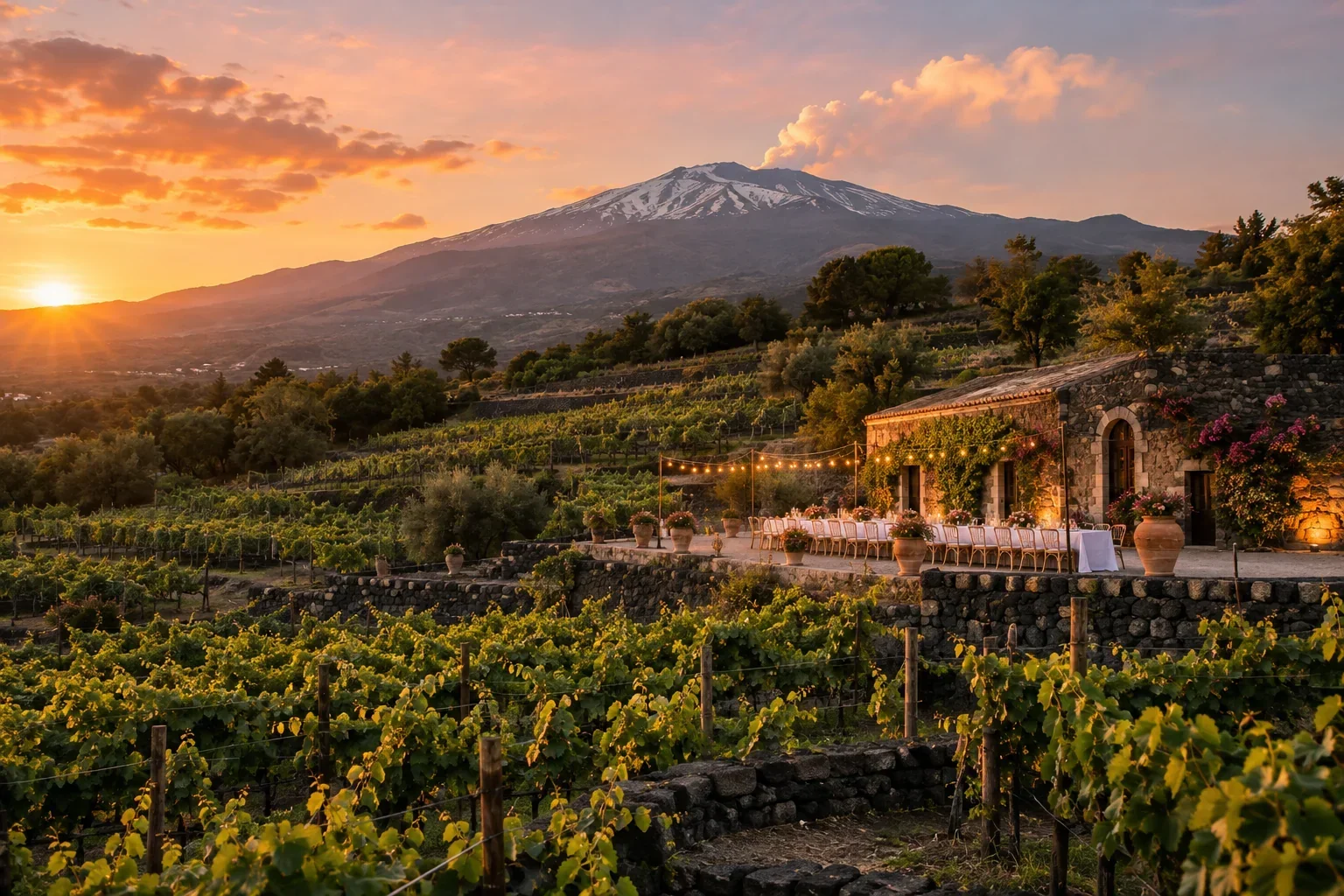
Most destinations offer one great view. Etna offers a whole sequence of them within a short drive. On the lower slopes the landscape is soft and cultivated: vineyards on narrow terraces, old palmenti where grapes were once pressed by foot, citrus and olive groves, villages built in grey lava stone. Higher up, the land empties out. Above about 1,800 metres there are old craters, cooled lava flows and a silence that feels almost lunar.
For a wedding film, that range is a gift. The ceremony can take place among the vines in the warm light of late afternoon, and the portraits can move from the green of the lower slopes to the black of the lava in a single hour. Very few places let you tell a story with that much contrast without leaving the same mountain.
Etna is also a working landscape, not a stage set. People live and farm here, wine is made here, and the volcano is still active. That honesty is part of what makes a film shot here feel true rather than decorative.
Where to Celebrate on Etna
Most Etna weddings take place on the eastern and northern slopes, between Zafferana Etnea, Linguaglossa and Castiglione di Sicilia, where the wine country is and where the views open towards the sea. These are four venues that show the range of what the mountain offers.
Monaci delle Terre Nere, Zafferana Etnea
A Relais & Châteaux estate and organic wine farm on the eastern slopes, with vineyards, citrus gardens and lava-stone terraces looking out to the Ionian coast. Ceremonies and dinners can be set in the olive grove, in a garden designed for celebrations, around the pool terraces or on a rooftop above the kitchen garden. The whole estate can be reserved, so guests stay together for the weekend. We describe it in more detail in our guide to weddings in Catania.
Villa Neri Resort & Spa, Linguaglossa
A small five-star hotel on the north-eastern slopes, with around two dozen rooms, a spa and gardens that look towards the volcano and the vines. Its architecture is clean and contemporary rather than rustic, which suits couples who want Etna's landscape with a quieter, more modern frame around it.
Il Picciolo Etna Golf Resort: Castiglione di Sicilia
A resort on the northern side of the mountain, built around a golf course with uninterrupted views of the summit. It has a large hotel of its own, gardens and terraces for receptions, and spaces for the ceremony on site, which makes it one of the few places on Etna where a large group can celebrate and sleep in the same place.
Castello di San Marco, Calatabiano
A historic castle turned hotel at the foot of Etna, on the coast between Taormina and Catania, with gardens, a spa and a private beach a few minutes' walk away. It is a natural choice for couples who want a coastal wedding with Etna on the horizon, and it is close enough to Taormina for guests to explore both.
Many couples also hold the ceremony in a church or at the town hall of one of the Etna villages and then move to an estate for the reception. If you plan a legal ceremony, check early which spaces your comune has authorised for civil weddings: our guide to getting married in Sicily explains the documents and timings.
Filming at Altitude: What the Volcano Allows
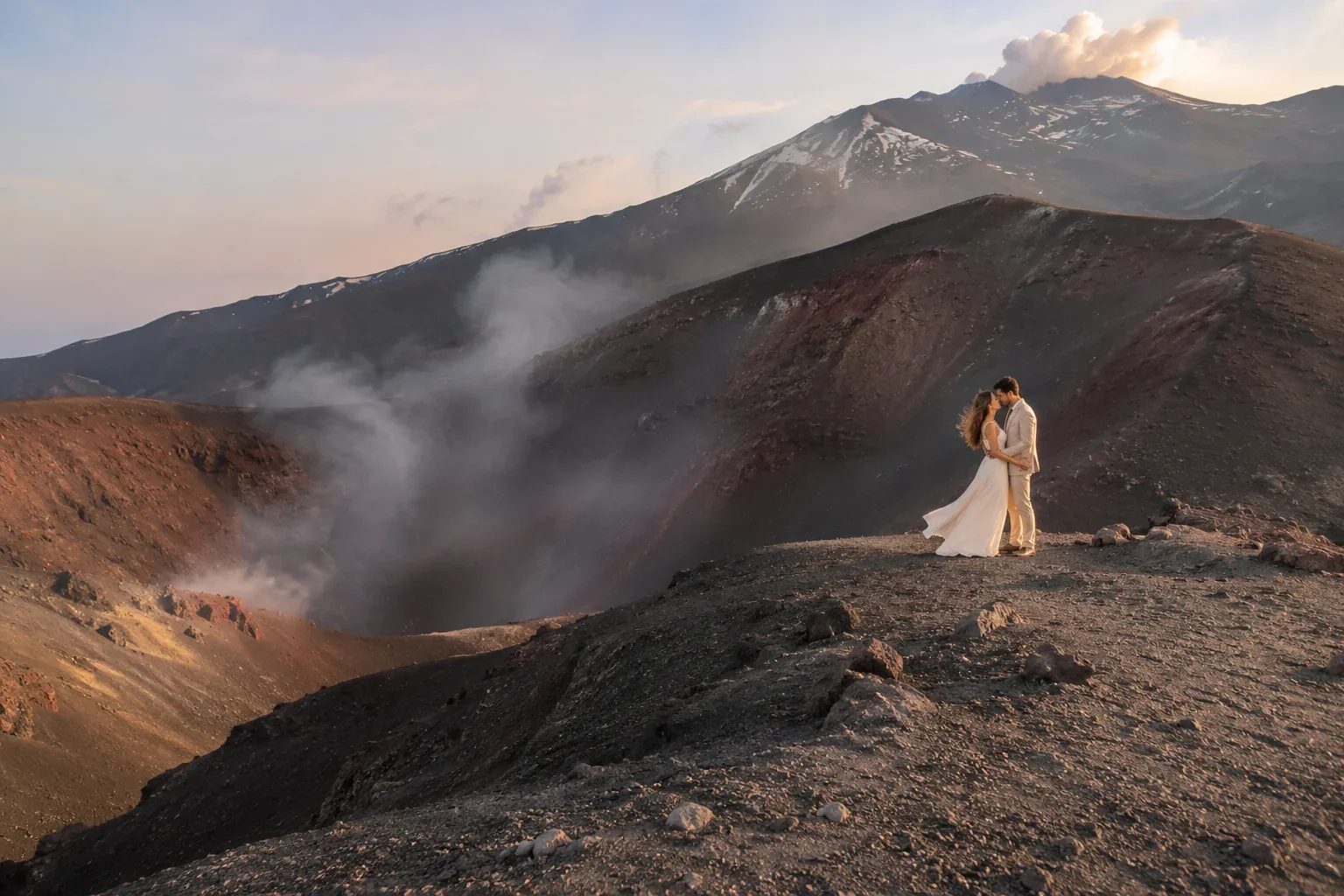
Many couples ask us for portraits among the craters. It is possible, and it can be the most extraordinary part of a film, but the mountain sets the rules, not us.
- The lower craters are the realistic choice. On the southern side, the Silvestri craters near Rifugio Sapienza, at around 1,900 metres, can be reached by road and walked in half an hour. They give the black-lava landscape most couples imagine, without an expedition in wedding clothes.
- The summit is a different world. Above about 2,500 metres access depends on the volcano's alert level and on local ordinances, and the area around the active summit craters can only be visited with authorised guides. When Etna is erupting, access can close from one day to the next.
- The weather changes fast. It can be 30°C in a vineyard at 600 metres and cold and windy at 2,000 metres on the same afternoon. In spring and autumn there can be snow on the upper slopes. We always plan an alternative at lower altitude.
- Drones follow national rules. Flying is governed by ENAC and by the restricted zones around Catania airport, and volcanic activity can bring its own temporary limits. Raffaele is an ENAC-certified drone pilot, and we check the zones and restrictions for the exact place and date before the day.
The easiest way to have both is what Gianluca and Flavia did: a separate session on the volcano before the wedding day, with time, comfortable shoes and no guests waiting. You can see their film in their wedding story, from the Duomo di San Giorgio in Ragusa Ibla to the lava fields of Etna.
The Best Season for a Wedding on Etna
Altitude changes the calendar. The slopes are cooler than the coast, which makes summer more comfortable at the estates, but the upper mountain is only reliably accessible from late spring to mid-autumn.
- May and June: the broom flowers turn the lower slopes yellow, the light is soft and the evenings are mild. Our favourite time on the mountain.
- July and August: warm days, cool evenings at the estates and the clearest views of the summit. Plan the ceremony late, when the heat drops.
- September and October: the grape harvest. Vineyards in full colour, warm stone and golden light, and the chance to include the vendemmia in your film.
- Winter: snow on the summit and real cold at altitude. Beautiful for an elopement, harder for a full wedding outdoors.
Our month-by-month guide to the best time to marry in Sicily goes into more detail on light, weather and crowds.
How We Film a Wedding on Etna
We treat the volcano as a character, not a backdrop. That means planning the day around its light: the summit is often clearest in the morning, and the slopes turn gold in the last hour before sunset, when the shadows of the old craters stretch across the vineyards. We place the ceremony where the mountain can be seen behind you, and keep at least one camera wide enough to show how small and how close everything is under it.
Sound matters as much as image here. Vineyard ceremonies are often windy, so we use microphones on the couple and the officiant rather than relying on the cameras. And because Etna weddings are often spread across a weekend, from a welcome dinner in a palmento to a beach day on the Ionian coast, we plan coverage with you so the film tells the whole story rather than just the wedding day.
Frequently Asked Questions
Can you get married on Mount Etna?
Yes. Most Etna weddings take place at wine estates, villas and hotels on the lower slopes, between Zafferana Etnea, Linguaglossa and Castiglione di Sicilia. A legal ceremony can be held in a church or in a space authorised by the local comune, and a symbolic ceremony can be held at the venue itself.
Can we take wedding photos and film at the craters?
Yes, at the lower craters. The Silvestri craters on the southern side, at around 1,900 metres, can be reached by road and are the most practical choice. The summit area depends on the volcano's alert level and can only be visited with authorised guides, so we always plan a lower alternative.
How far is Etna from Catania airport?
Most wine estates on the eastern and northern slopes are 40 to 60 minutes from Catania airport by car, and Taormina is about 30 to 40 minutes from the north-eastern slopes.
What is the best month for a wedding on Etna?
May, June, September and October. Spring brings flowering broom and mild evenings, while September and October coincide with the grape harvest. July and August are warm on the coast but more comfortable at the estates thanks to the altitude.
Is it safe to plan a wedding near an active volcano?
Yes. The estates and villages on the lower slopes are lived in and visited all year. Eruptions can affect access to the upper mountain and, occasionally, flights at Catania airport, so it is wise to keep the day flexible and to follow the official updates in the weeks before.
Can you fly a drone on Etna?
Often, but not everywhere. Drone flights follow ENAC rules and the restricted zones around Catania airport, and volcanic activity can bring temporary limits. We are ENAC certified and check the zones for the exact location and date before the wedding.
Planning a wedding on Mount Etna?
Tell us your date, your venue and how you imagine the day, and we will tell you how we would film it on the volcano.
Tell us about your wedding