Getting Married in Sicily: Documents, Ceremonies and Timelines for Foreign Couples
Getting married in Sicily is easier than most couples fear — but only if you decide early which kind of ceremony you want. Everything else, from the paperwork to the order of your day, follows from that one choice.
There are three ways to marry here: a civil ceremony at a town hall or an authorised venue, a Catholic ceremony in church, or a symbolic ceremony anywhere you like. The first two are legally binding and need documents from your home country. The third has no legal value on its own, which is exactly why so many international couples choose it.
This guide explains how each one works for couples coming from the United States, the United Kingdom and Australia, what to prepare and when, and how the choice changes the way your day — and your film — unfolds. We film weddings across Sicily every season, so we see all three from very close.
- Ceremony types
- Civil, Catholic or symbolic
- Start the paperwork
- 4 to 6 months before
- Arrive in Sicily
- 2 to 3 working days before
- Simplest option
- Legal at home, symbolic in Sicily
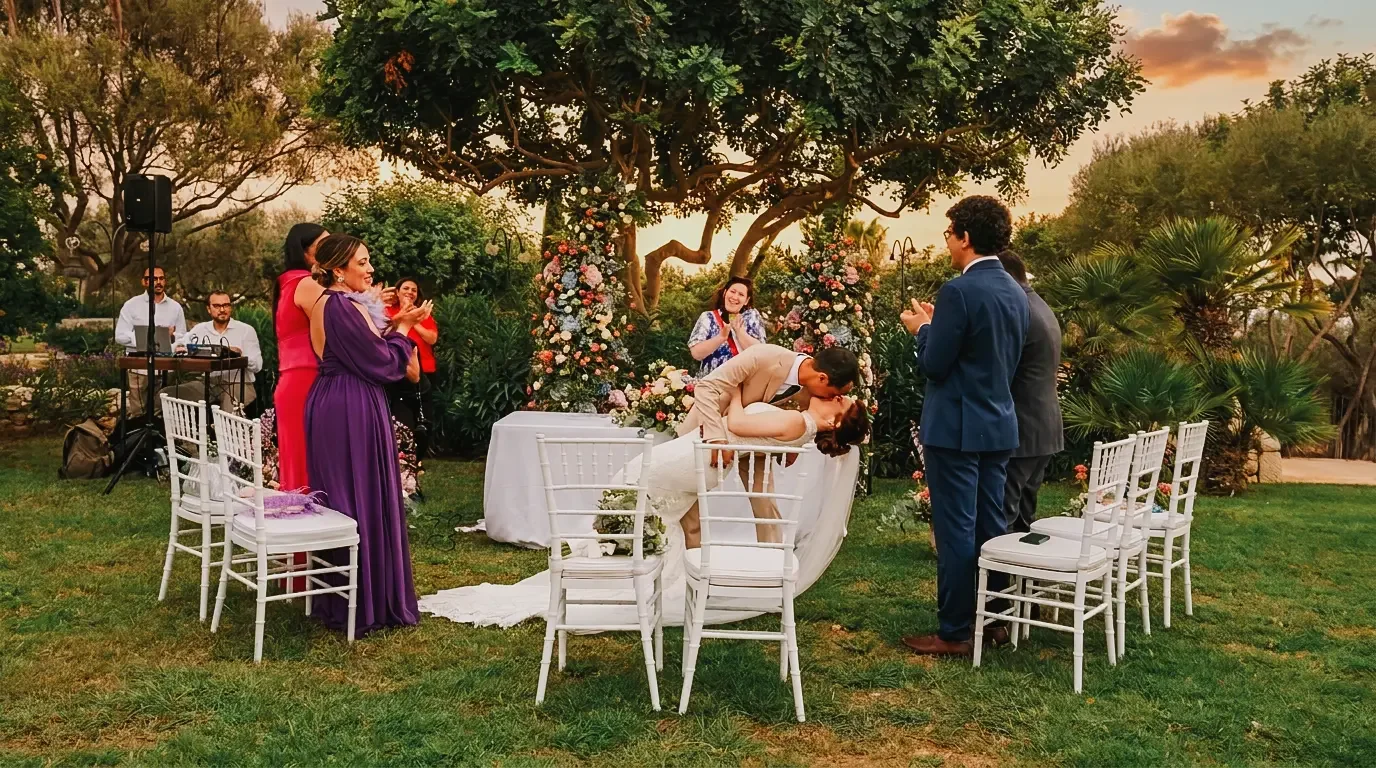
Civil, Catholic or Symbolic: Choosing Your Ceremony
Before you collect a single document, decide what the ceremony in Sicily has to do. If it must make you legally married, you need a civil or a Catholic ceremony and the paperwork that goes with it. If you are happy to sign the legal part at home, a symbolic ceremony frees you from almost all of it.
| Ceremony | Legally valid | Where | Paperwork |
|---|---|---|---|
| Civil | Yes | Town hall or a venue authorised by the comune | Full set of civil documents |
| Catholic | Yes, with civil effect | A church, with the parish’s consent | Civil documents plus church documents |
| Symbolic | No | Anywhere: villa, garden, beach, terrace | None in Italy |
The civil ceremony
A civil wedding is celebrated by the mayor or a delegated official, in Italian, with an interpreter translating for you and your guests. It is short — usually around twenty to thirty minutes — and you need two witnesses over eighteen, who can be friends or family.
It does not have to happen in an office. Many Sicilian towns have authorised historic buildings and private venues for civil ceremonies: in Taormina, for example, Palazzo Duchi di Santo Stefano, and in Modica the venues approved by the Comune. Ask your venue whether it is on the list before you book anything else.
The Catholic ceremony
A Catholic wedding in Italy is a concordat marriage: the priest reads the articles of the civil code during the ceremony, and the marriage is then registered with the town hall, so it is valid both in church and in law. That means you need the civil documents and the church ones — baptism and confirmation certificates, a letter of freedom to marry and a pre-marriage course — gathered through your home parish and sent with a nihil obstat from your own bishop to the diocese where you will marry.
Start with your parish priest at home, at least six months ahead. The Sicilian parish and diocese decide on dates, readings and music, and each church has its own rules.
The symbolic ceremony
A symbolic ceremony has no legal value in Italy, so you sign the legal part at home — at a registry office or a courthouse — a few days or weeks before you fly, and celebrate in Sicily exactly as you want. It can be led by a celebrant, a friend or a family member, in your own language, at any time of day and in any place your venue allows.
For most of the international couples we film, this is the right answer. It removes the paperwork, the interpreter and the town hall timetable, and it lets you put the ceremony where the light is best. Many couples also choose it for an elopement in Sicily.
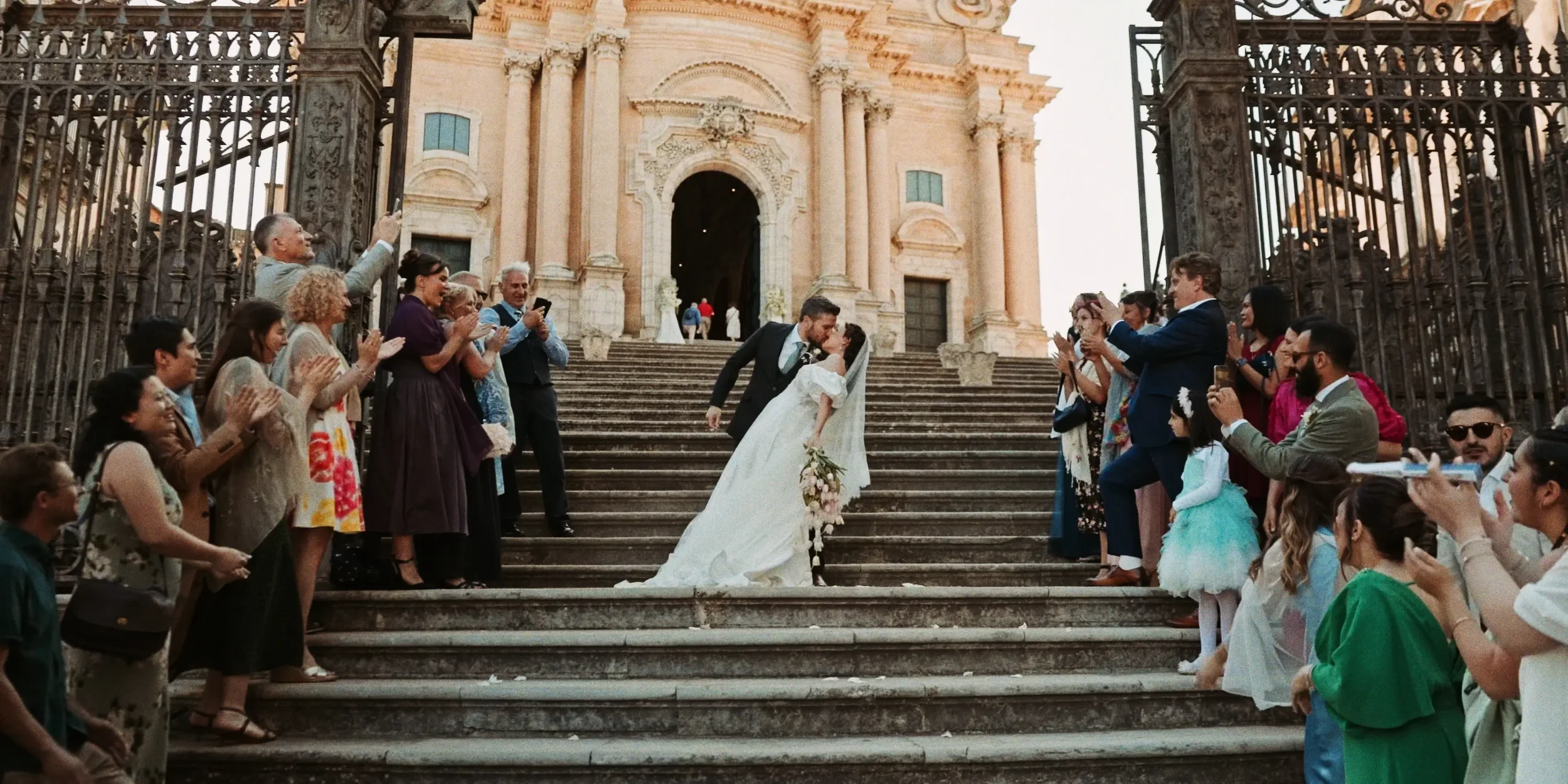
The Documents You Need for a Legal Wedding in Sicily
For a civil or Catholic wedding, Italy asks every foreign spouse for the same thing in different forms: proof that you are free to marry. The papers that prove it depend on your passport, and the rules change from time to time, so treat what follows as a map and confirm each step with the official source for your country and with the comune where you will marry.
Couples from the United States
- Atto Notorio — a sworn declaration made at an Italian consulate in the US, with two witnesses for each of you who are not close relatives. Consulates set their own validity; San Francisco, for example, gives 90 days.
- Dichiarazione Giurata — a sworn statement signed in person at the US Embassy or a US consulate in Italy, once you have arrived. It is then legalised at the local Prefettura with a revenue stamp.
- Proof that any previous marriage has ended — divorce decree or death certificate, with apostille and certified Italian translation. Some comuni also ask for birth certificates.
Couples from the United Kingdom
- Certificate of no impediment — known in Italy as the nulla osta. How you obtain it depends on where you live: through a UK register office if you live in the UK, or through the British Embassy in Rome if you do not.
- Apostille and translation — UK documents have to be apostilled and translated into Italian before the comune accepts them.
- The process has changed more than once in recent years, so start from the current GOV.UK guidance on marriage abroad for Italy.
Couples from Australia
- Nulla osta — sworn in person at the Australian Embassy in Rome or the Consulate-General in Milan. It cannot be sworn outside Italy, it is valid for six months and it must be legalised at a Prefettura.
- Atto Notorio — from an Italian consulate in Australia before you travel, or from a court in Italy, with two witnesses.
- Apostille on your Italian marriage certificate — issued by the Prefettura after the wedding, so that the marriage is recognised at home.
The step couples forget is the declaration of intent to marry at the town hall. You make it in person, with an interpreter and two witnesses, usually two or three working days before the wedding. Plan your flights around it, not around the rehearsal dinner.
A Realistic Timeline
- Twelve months before: choose the ceremony type, then the town and the venue. For a civil wedding, check that the venue is authorised by the comune; for a Catholic one, speak to your parish priest.
- Six months before: confirm the date with the comune or the Sicilian parish and ask for their list of documents. Start the church file if you are marrying in church.
- Four to three months before: request birth certificates, divorce decrees and apostilles; book the consulate appointment for the Atto Notorio inside its validity window; arrange certified translations.
- The week of the wedding: arrive at least two or three working days early for the sworn statement or nulla osta, the Prefettura and the declaration at the town hall.
- After the wedding: collect the marriage certificate, have it apostilled at the Prefettura, and register the marriage at home if your country requires it.
A local planner or the venue’s wedding coordinator usually handles the Italian side — appointments, interpreter, translations — and it is money well spent. If you are planning from America, our guide on how to plan a wedding in Sicily from the US covers the rest of the logistics.
How Each Ceremony Shapes Your Wedding Film
The legal choice also decides how much freedom we have behind the camera, and it is worth knowing before you plan the day.
- Civil ceremony: the time is set by the comune, often late morning or early afternoon, so the light is what it is. We place a microphone on the officiant and one on the interpreter, because the vows are spoken twice, in Italian and in English, and both matter in the edit.
- Catholic ceremony: the priest decides where we can stand and whether we can move during the rite. Some churches allow us near the altar, others only at the back. We always speak to the priest before the day, and Sicilian churches — Baroque, gilded, often dim — reward that planning.
- Symbolic ceremony: you choose the hour, so you can put the vows in the last golden hour of the day. It is the ceremony that gives the most cinematic results, and the one where we can be closest without being noticed.
Many of our couples combine two: a short civil or church ceremony in the morning for the family, and a symbolic exchange of vows at sunset, at the villa, in their own words. On film it gives the day two very different moments of emotion.
Frequently Asked Questions
Can foreigners legally get married in Sicily?
Yes. Couples from the US, the UK, Australia and elsewhere can have a legally valid civil or Catholic wedding in Sicily, as long as each spouse provides proof of being free to marry and makes a declaration of intent at the town hall a few days before the ceremony.
Is a wedding in Sicily legally recognised in the US, the UK and Australia?
Yes. A marriage celebrated under Italian law is generally recognised at home. Ask the town hall for your marriage certificate and have it apostilled at the Prefettura before you leave, so that it can be used in your home country.
How far in advance should we start the paperwork?
Four to six months before the wedding for a civil ceremony, and at least six months for a Catholic one, because the church file goes through your own parish and bishop. Some documents expire, so do not collect them too early either.
How many days before the wedding do we need to be in Sicily?
At least two or three working days for a civil or Catholic wedding, to sign the sworn statements, have them legalised and make the declaration of intent at the town hall. For a symbolic ceremony there is no minimum.
Can we have a civil wedding outside the town hall?
Yes, in venues that the comune has authorised for civil ceremonies, such as historic palazzi and some villas and hotels. Check with your venue that it is on the list before you book.
Do we need a translator?
Yes, for any legal ceremony. If either of you does not speak Italian, an interpreter must be present at the declaration of intent and at the ceremony, and cannot be one of the spouses.
Why do so many couples choose a symbolic ceremony?
Because it removes almost all of the paperwork. You marry legally at home, then celebrate in Sicily at the time and place you choose, in your own language, with no town hall timetable and no interpreter.
Official sources: Consulate of Italy in San Francisco · GOV.UK · Australian Embassy in Rome. Requirements change: always confirm with them and with your comune.
Planning a wedding in Sicily?
Tell us your date, your venue and the kind of ceremony you have in mind, and we will tell you how we would film it.
Tell us about your wedding