The most beautiful places to marry in Sicily are also the most regulated. Baroque churches, Greek temples, nature reserves and historic palazzi all come with rules about where a camera can stand, when it can move and whether a drone can fly. Couples rarely hear about them until something goes wrong.
None of these rules should stop you from choosing the place you love. They simply need to be known in advance and planned for, ideally by the people who will be filming. This guide explains, from our side of the camera, what changes in church, at a civil ceremony, at monuments and archaeological sites, with drones, and with your guests' privacy.
It is not legal advice, and rules change from place to place and from year to year. But it will help you ask the right questions early, which is almost always enough.
- In church
- The priest decides
- At monuments
- Prior authorisation, sometimes a fee
- Drones
- ENAC rules and D-Flight zones
- When to ask
- As soon as the venue is booked
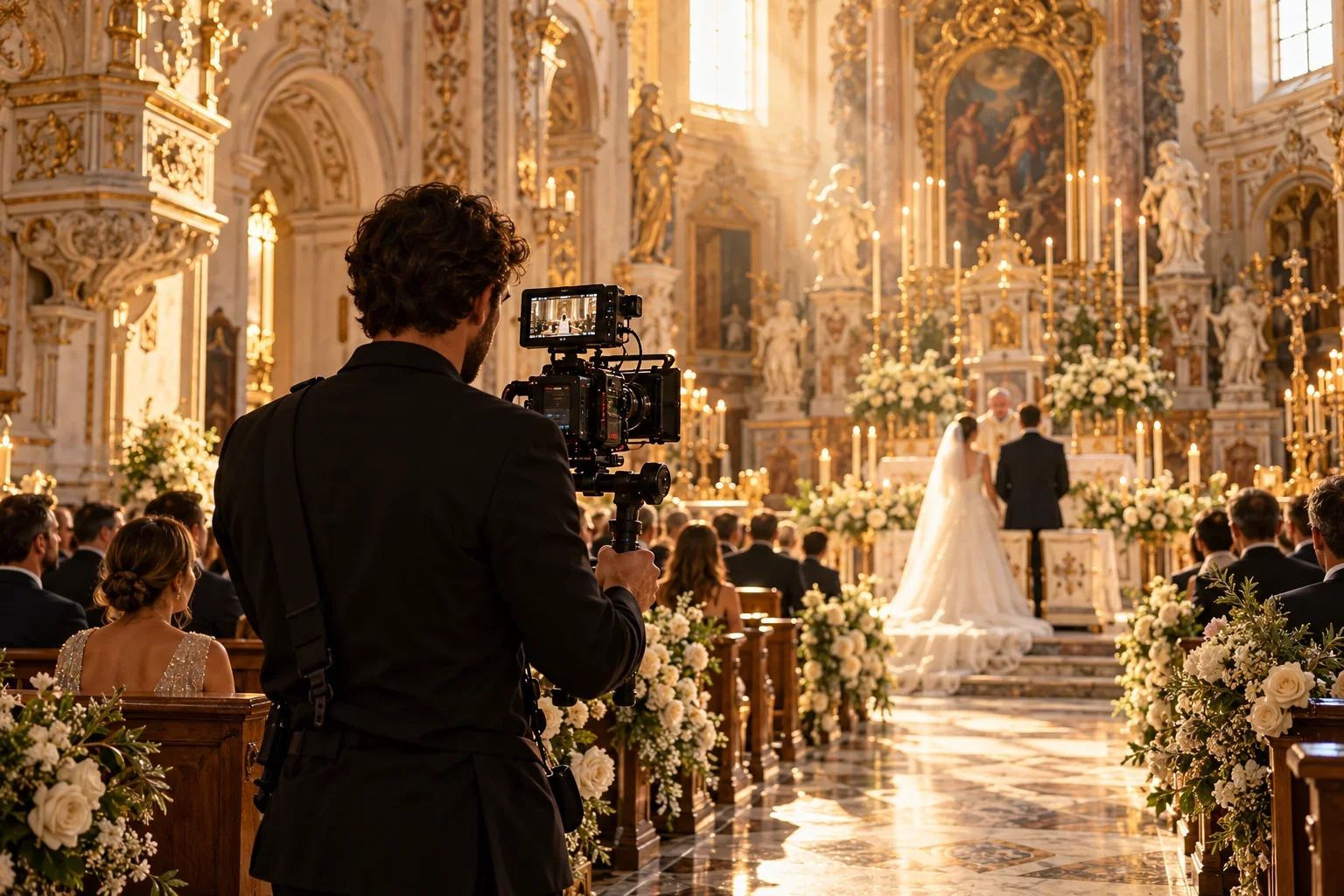
Filming a Catholic Ceremony in a Sicilian Church
In a Catholic wedding, the church is a place of worship first and a set second, and the parish priest has the final word on what happens during the rite. In Italy there is no single national rule for photographers and videographers: each diocese and each parish sets its own, and some Italian dioceses go as far as asking outside photographers and videographers for an accreditation or a written permission before every wedding.
In practice, these are the things we are most often asked to respect:
- Where we stand. Some churches allow us close to the altar, others only along the side aisles or at the back. The sanctuary itself is often off limits.
- When we move. Many priests ask us to stay still during the most solemn moments of the Mass, such as the consecration.
- Light and noise. No flash, no extra lighting during the rite, silent cameras.
- How many of us. Some parishes limit the number of photographers and videographers present at the same time.
- Microphones. Most priests accept a small microphone on the groom and on the celebrant, or on the ambo, if asked beforehand. It is the only way to record your vows clearly in a large stone church.
We always speak with the priest before the wedding, in person or by phone, and we never discover the rules on the day. If you are planning a Catholic ceremony, our guide to getting married in Sicily explains the paperwork and the timings, which start months before.
Civil and Symbolic Ceremonies
A civil ceremony is a public act celebrated by the mayor or a delegated official, at the town hall or in a venue authorised by the comune. Filming is normally welcome, but the time is set by the comune, the ceremony is short, and, if needed, the interpreter translates after every sentence. We place a microphone on the officiant and one on the interpreter, so both languages can be used in the film.
A symbolic ceremony has no legal value and therefore no official rules: you decide the place, the time, the words and how close we can be. It is the most cinematic option precisely because nothing limits it, which is why many couples marry legally at home and celebrate in Sicily.
Monuments, Archaeological Parks and Historic Sites
Sicily's cultural heritage is managed by the Regione Siciliana through its archaeological parks, museums and regional superintendencies. When photographs or films are made for professional purposes in these places, they generally need prior authorisation from the body that manages the site, and often the payment of a fee.
This applies to some of the places couples dream of most: the Greek Theatre in Taormina, the Valley of the Temples in Agrigento, the Neapolis in Syracuse. Requests take time, the answer can include conditions on hours, equipment and the number of people, and some sites simply do not allow wedding shoots. The request is often sent by the photographer and videographer, and it has to start weeks before the wedding, not days.
Private historic venues, such as palazzi, castles and villas, have their own rules, written in your contract: where the cameras can go, how late the music can play, whether confetti and sparklers are allowed. Ask your venue for them early and share them with us.
Drones: What the Law Requires
Aerial footage is often what couples remember most about a Sicilian wedding film, and it is also the most regulated part of our work. In Italy drones follow the European rules applied by ENAC, the Italian civil aviation authority. In short:
- The operator must be registered on the D-Flight portal, with the registration code displayed on the drone, and the pilot must hold the certificate required for that drone.
- Insurance is mandatory for third-party liability.
- No flying over assemblies of people. The guests leaving the church, the dancing, the aperitivo: these are filmed from a safe distance or not from the air at all.
- Restricted zones. Areas around airports, such as Catania, Palermo, Trapani and Comiso, and other sensitive sites are restricted or need authorisation. The zones are published on D-Flight and can change for specific dates.
- Parks, reserves and beaches. Nature reserves and protected areas may restrict take-off and landing on their land, and beaches can be covered by local summer ordinances.
Raffaele is an ENAC-certified drone pilot. Before every wedding we check the zones and restrictions for the exact place and date, ask the venue's permission, and decide with you which moments are worth filming from the air. Sometimes the answer is none, and the film is no worse for it.
Your Guests' Privacy
A wedding film shows people, and some of them may not want to appear online. Professional filming in Europe falls under data protection rules, so the footage should be used only for the purposes you have agreed with your videographer. If a guest prefers not to be filmed, say so before the day, and agree in advance what can be shared or published, especially when children appear.
Frequently Asked Questions
Can a videographer film inside a church in Sicily?
Yes, in almost every church, but the parish priest decides where the camera can stand and when it can move. Some Italian dioceses also ask outside photographers and videographers for an accreditation or a written permission, so it is important to speak with the priest well before the wedding.
Can we record our vows in church?
Usually yes. Most priests accept a small microphone on the groom and on the celebrant, or on the ambo, if asked beforehand. It is the only way to record the vows clearly in a large stone church.
Do we need a permit for wedding photos at the Greek Theatre of Taormina or the Valley of the Temples?
Professional photography and filming at Sicilian archaeological parks and monuments generally need the prior authorisation of the body that manages the site, and often a fee. Requests should be sent several weeks before the wedding.
Is it legal to fly a drone at a wedding in Italy?
Yes, within the ENAC rules: the operator must be registered on D-Flight, the pilot certified and the flight insured, and drones may not fly over assemblies of people or in restricted zones such as those around airports without authorisation.
Who asks for the permits, the couple or the videographer?
Often the photographer and the videographer, because the permits concern their work and their equipment. The couple and the planner help by confirming the venue, the date and the timeline as early as possible.
Can a guest ask not to be filmed?
Yes. Tell your videographer before the wedding and they will avoid filming that person, or leave them out of anything that is shared or published.
Official sources: ENAC, drones in the open category · D-Flight · Regione Siciliana, use of cultural heritage. Rules change: always confirm with them before you plan.
Planning a wedding in a church or a historic place?
Tell us where and when, and we will tell you what to ask, what to book in advance and how we would film it.
Tell us about your wedding