Traditions, venues and a three-day celebration under the Mediterranean sun.
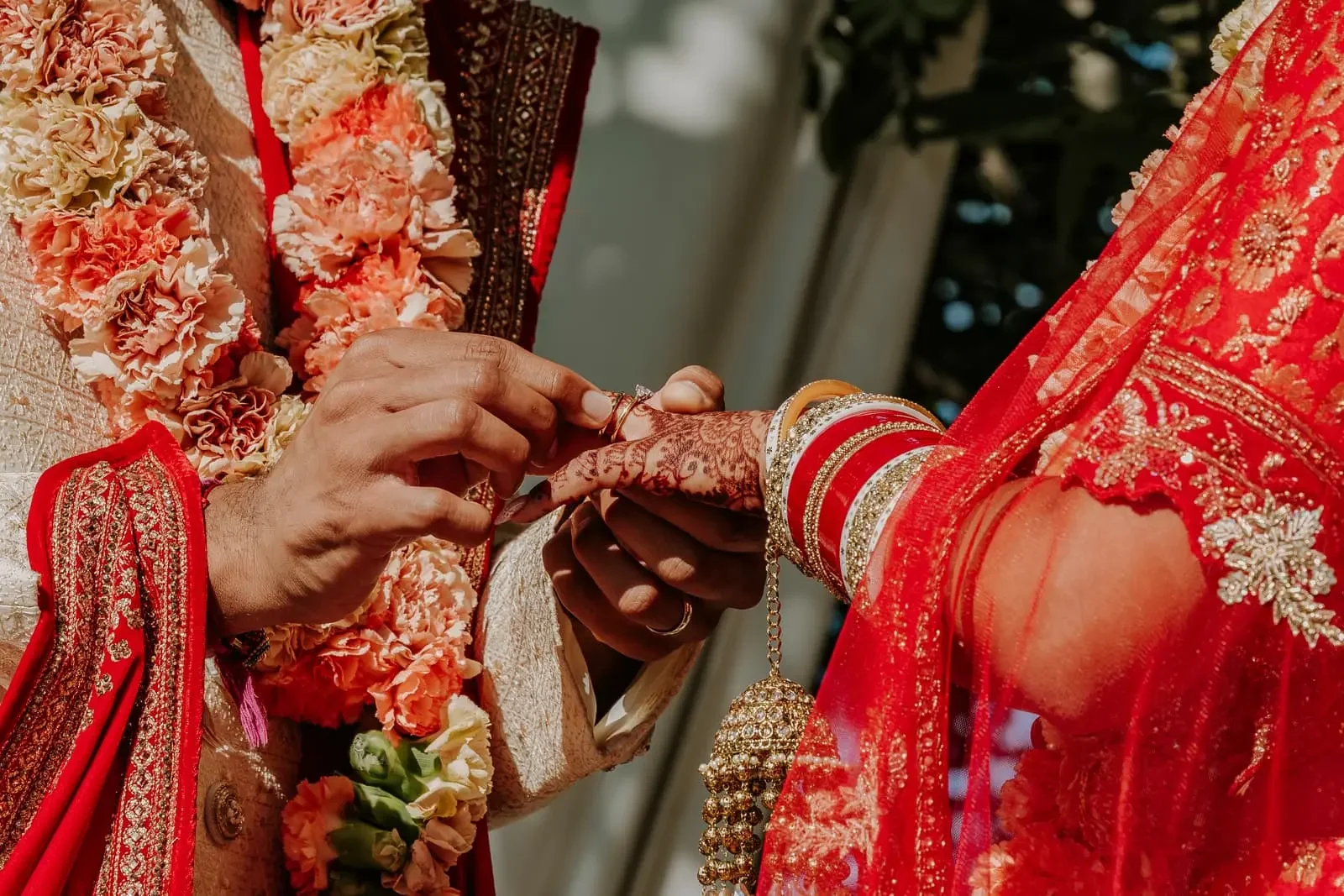
Few celebrations on earth match the scale, colour and emotional intensity of an Indian wedding. And few places can hold that celebration the way Sicily can.
Golden light that lasts into the late evening, aristocratic villas built for grand gatherings, and a food culture that treats hospitality as sacred: the island was made for weddings that unfold over days, not hours.
More and more couples from the Indian diaspora, from London, New York, Toronto and Dubai, are looking beyond Tuscany and the Amalfi Coast and discovering what a destination wedding in Sicily offers: larger venues at more generous rates, warm weather for longer stretches of the year, and a landscape dramatic enough to hold its own next to silk lehengas and marigold garlands.
This guide covers everything: the difference between an Indian wedding and a Hindu wedding, how the multi-day celebration unfolds, the practical questions every couple asks (legal ceremony, catering, guest logistics), and where in Sicily to host it all, whether your ceremony is Hindu, Sikh, Muslim or a blend of traditions.
Why Sicily Works So Well for an Indian Wedding
An Indian wedding is rarely a single event. It is a sequence of ceremonies spread across two, three, sometimes four days, each with its own dress code, its own music and its own emotional register, and each needing space. This is where Sicily quietly outperforms the more famous Italian regions.
- Space and scale
- Sicilian estates were built by families who entertained in numbers. Historic bagli, aristocratic villas and wine estates routinely host 150 to 300 guests across gardens, courtyards and terraces, so the Haldi, the Sangeet and the wedding ceremony can each have a setting of their own without anyone leaving the property.
- Weather you can plan around
- From late April through October, outdoor ceremonies are not a gamble but the default. A Mandap in a citrus garden in May, a Sangeet under the stars in September: in Sicily these are safe bets, not weather-dependent hopes.
- Value
- Compared with Lake Como, Tuscany or the Amalfi Coast, Sicily offers venues of equal, often greater, architectural character at noticeably lower cost. That matters when you are hosting 200 guests for three days rather than 80 for one evening.
- The light
- Ask any wedding filmmaker. The long golden hour of the Sicilian south-east, over the honey-coloured Baroque stone of Ragusa Ibla and the towns of the Val di Noto, does something to red and gold silk that has to be seen to be believed.
Indian Wedding or Hindu Wedding? A Distinction Worth Making
The two terms are often used interchangeably, but they describe different things, and if you are planning one the difference matters.
“Indian wedding” describes cultural origin. India is home to many faiths, and an Indian wedding may be Hindu, Sikh, Muslim, Christian or Jain, or a blend of traditions, as is increasingly common among diaspora couples marrying across communities.
“Hindu wedding” describes the religious ceremony itself: the rituals performed under the Mandap, officiated by a pandit and centred on the sacred fire. It is the ceremony most people picture when they imagine an Indian wedding, but it is one tradition among several.
The Sikh wedding — Anand Karaj
The ceremony traditionally takes place in a gurdwara, in the presence of the Guru Granth Sahib, with the couple circling the holy scripture four times in the Laavan. Since there is no established gurdwara near Sicily’s wedding venues, Sikh couples marrying on the island usually hold the Anand Karaj at home before travelling and then celebrate in Sicily with the full festive arc (Mehndi, Sangeet, Baraat and reception), or arrange a respectful adapted ceremony with their granthi.
The Muslim wedding — Nikah
The Nikah is a beautifully contained ceremony (the marriage contract, the Mahr, the presence of witnesses) that adapts easily to a Sicilian villa or garden, officiated by an imam who travels with the family or is found through the Islamic communities of Palermo and Catania. The Walima reception that follows suits the island’s talent for celebration perfectly. Halal catering is readily available and should be confirmed at the first conversation.
Interfaith and double ceremonies
Some of the most memorable destination weddings blend traditions: a Hindu ceremony under the Mandap one day and a civil or Christian ceremony the next, or a fusion ceremony written with both families. Sicily, itself a layering of Greek, Arab, Norman and Spanish cultures, is a rather poetic place to do it.
The Structure of a Multi-Day Indian Wedding in Sicily
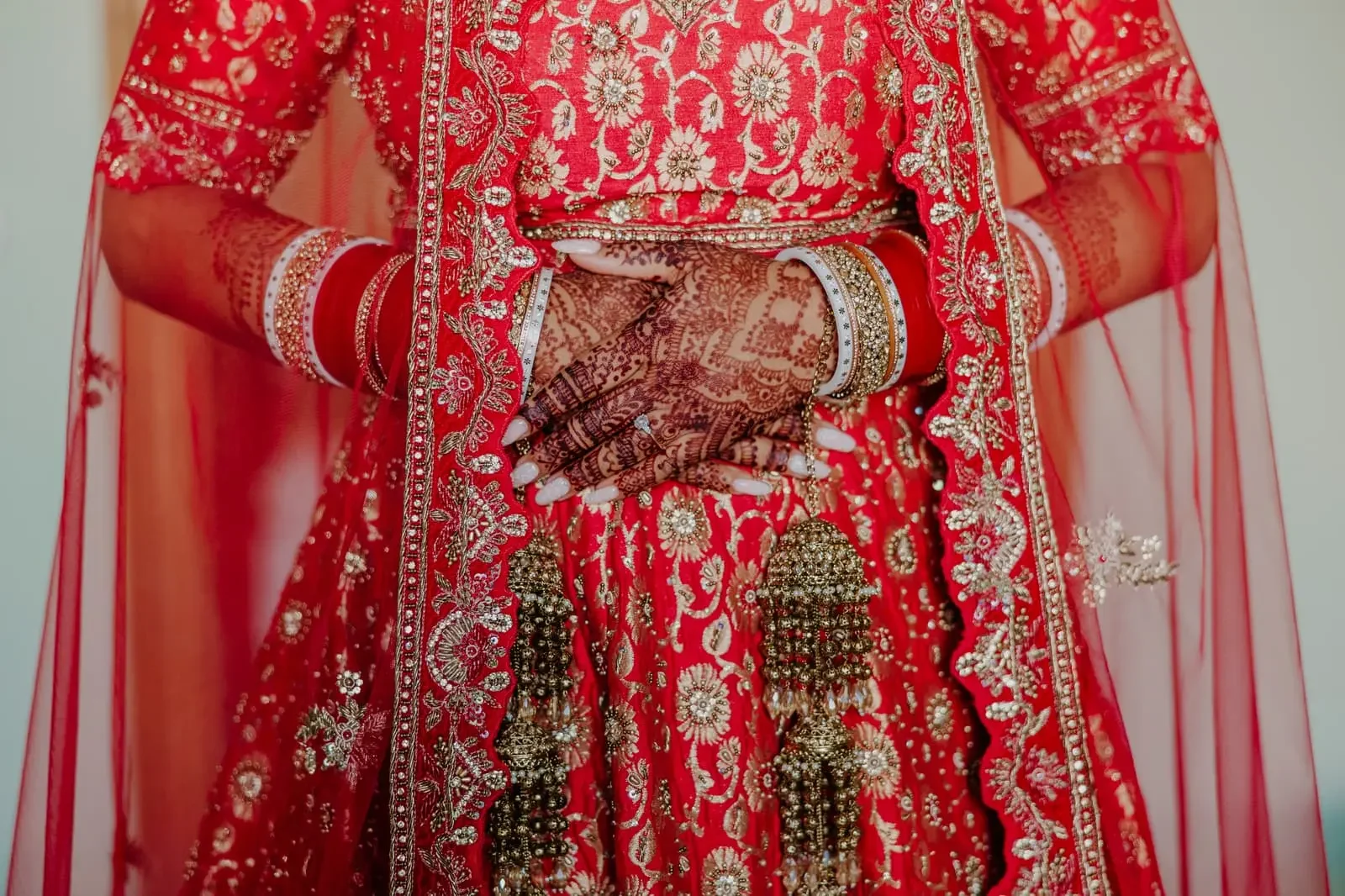
Every family shapes the celebration differently, but a typical three-day celebration built around a Hindu ceremony flows something like this. Haldi, Mehndi and Sangeet are rooted in Hindu and North Indian custom, but they are widely embraced across communities as the festive heart of the wedding week.
Day One — Welcome, Haldi & Mehndi
The celebration usually opens with a relaxed welcome as guests arrive from around the world, often an aperitivo-style evening that lets Sicilian hospitality make the first impression: local wines, street-food stations, live music in a courtyard.
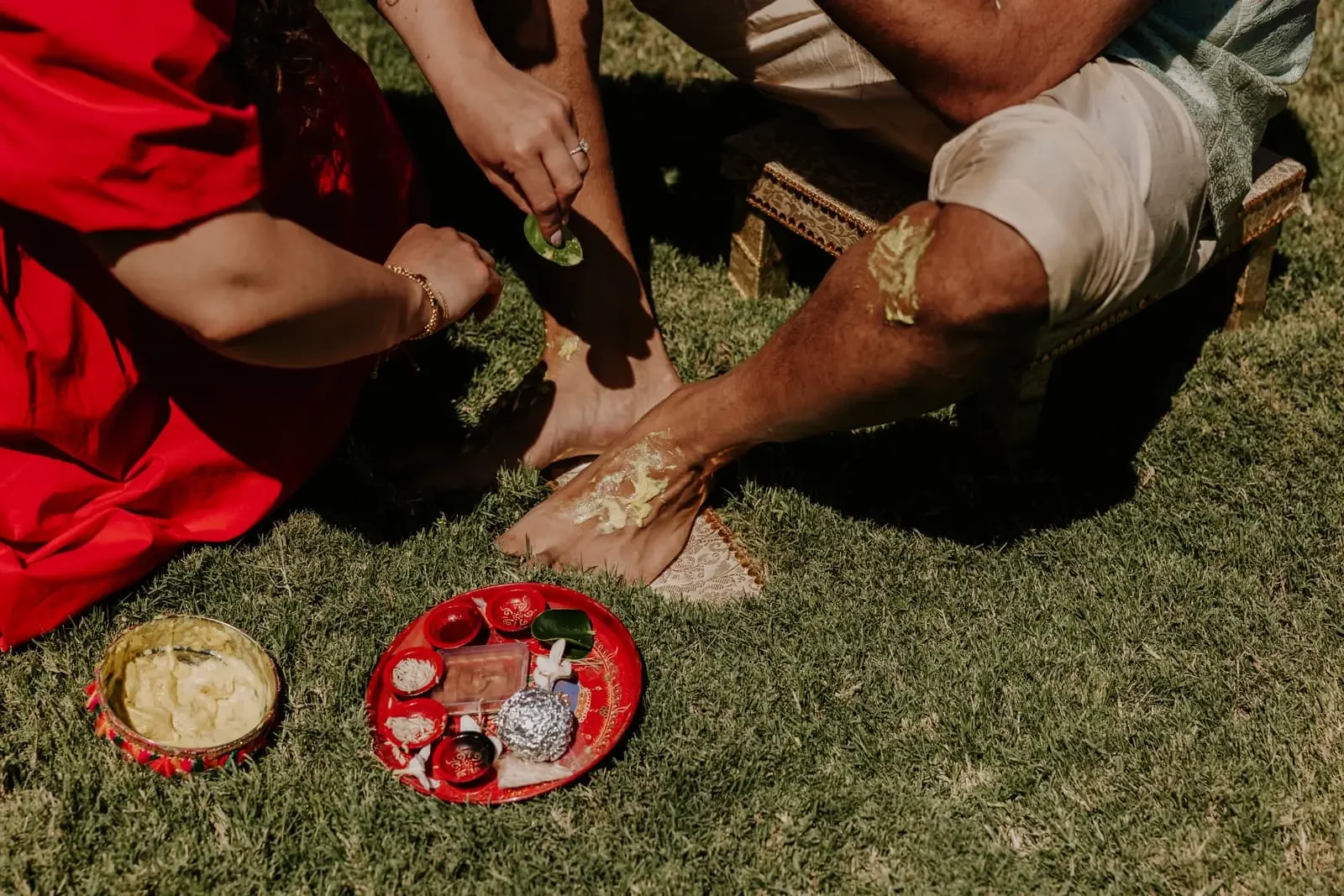
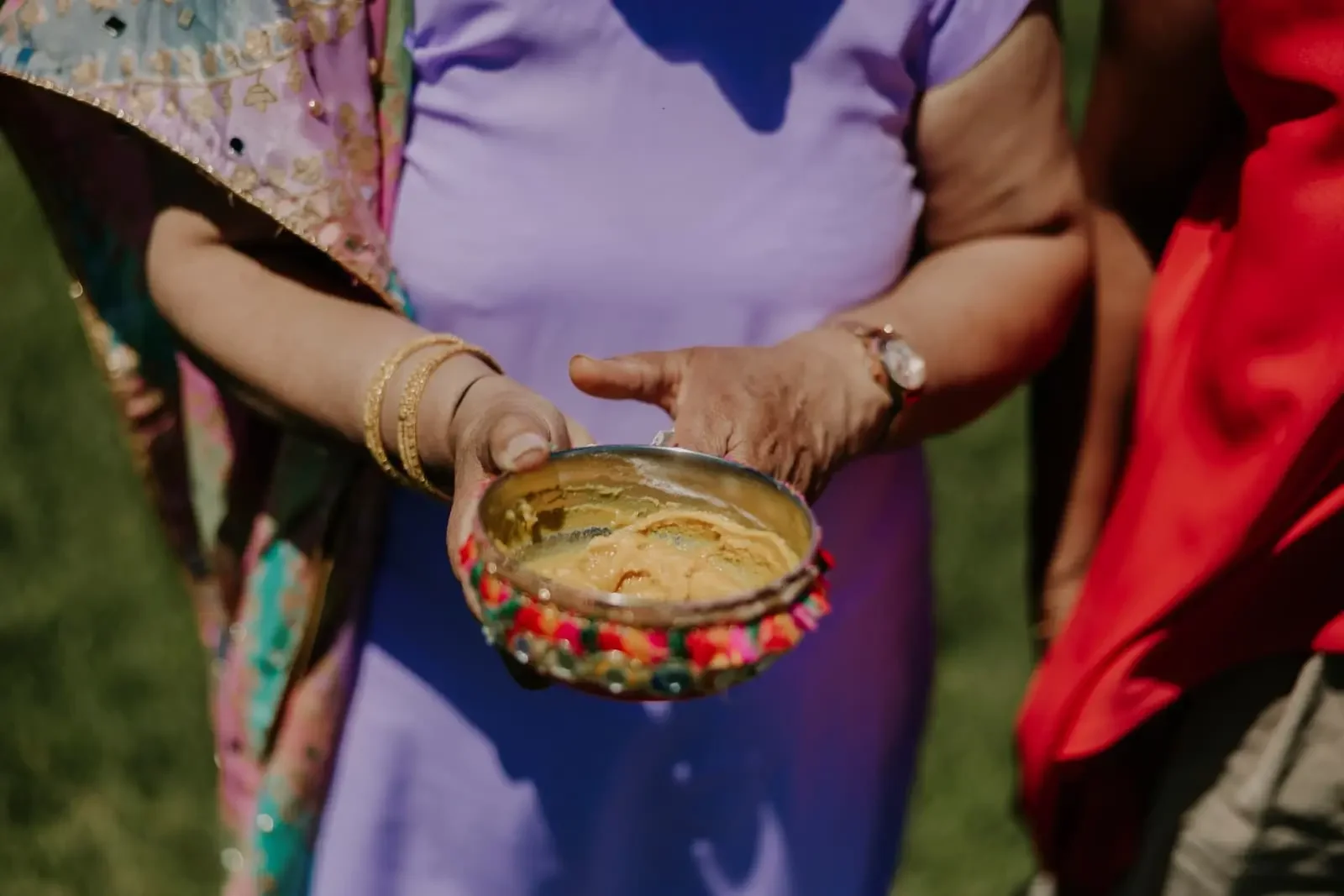
The Haldi, when family members lovingly apply turmeric paste to the bride and groom for blessing and glow, works beautifully outdoors in a Sicilian garden, ideally in the morning or late afternoon. Yellow flowers, yellow fabrics, yellow everything: against a backdrop of lemon trees, the colour story writes itself.
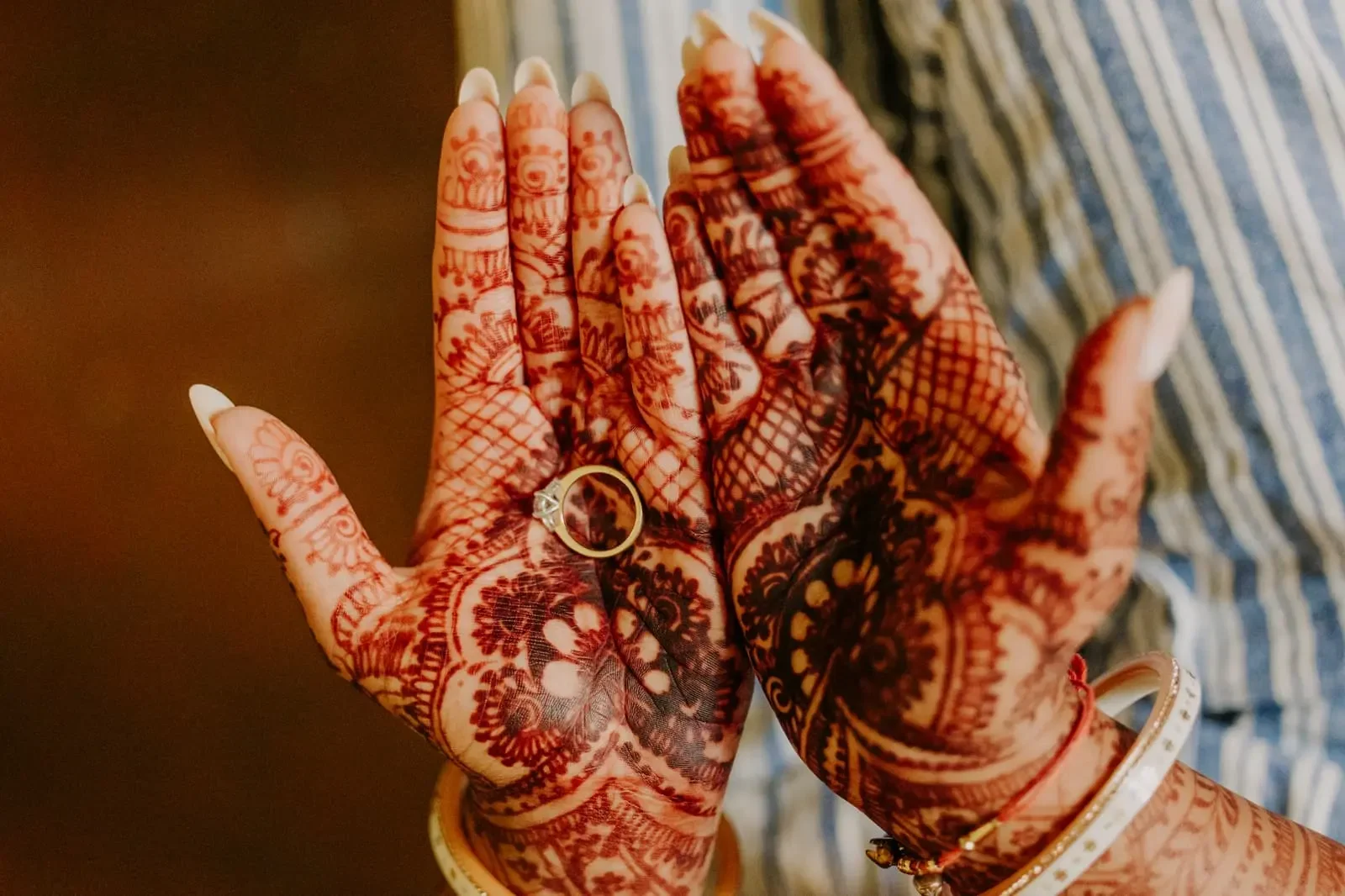
The Mehndi follows, often the same day or the next morning: hours of intricate henna on the bride’s hands and feet, surrounded by music, tea and conversation. A practical note: mehndi artists usually travel with the family or are flown in from elsewhere in Europe, so build their travel into the budget early. The bridal mehndi alone can take three to five hours.
Day Two — The Sangeet
The Sangeet is the emotional heart of the pre-wedding celebrations: an evening of choreographed dances, family performances and toasts, and frankly the best party of the weekend. This is where Sicily’s venues shine: a terrace above the sea, the torch-lit courtyard of a baglio, a stage set against Baroque architecture.
What to plan for: a proper dance floor and stage; professional sound and lighting (confirm the venue’s power capacity, the most overlooked technical detail of all); a DJ who knows the Bollywood and bhangra catalogues; and a dinner service that can flex around the performances rather than fight them.
The Baraat turning the corner of a Baroque lane is one of the most cinematic moments a wedding film can hold.
Day Three — Baraat, the Hindu Ceremony & Reception
The wedding day opens with the Baraat, the groom’s procession, traditionally on a white horse with dhol drummers and dancing family members. Yes, it is possible in Sicily: horses can be arranged through local equestrian providers, and a procession down a villa’s tree-lined drive or a Baroque town’s stone lane is unforgettable on film. Vintage cars, decorated Apes (the classic Sicilian three-wheeler) and even boats have served as creative alternatives.
The Hindu ceremony takes place under the Mandap, the four-pillared canopy that frames the sacred rituals. Sicilian florists and set designers have grown increasingly experienced with Mandap construction: draped fabrics, marigold and rose installations, and structures built to withstand a coastal breeze.
Its timing is not set by the schedule. The pandit chooses the Muhurat, the auspicious hour, from the couple’s birth details, and it can fall at noon in July as easily as at sunset. Ask for it before you plan anything else on the wedding day: in Sicily it decides the shade over the Mandap, the comfort of your guests and the light the ceremony is filmed in.
The rituals vary considerably by region, community and family, and no two pandits run the ceremony in quite the same way. But most Hindu weddings move through a recognisable arc.
- Arrival and Milni
- The groom arrives at the end of the Baraat and is welcomed by the bride’s family, often with the Milni, when the senior men of the two families embrace. The bride’s entrance follows, frequently beneath a Phoolon ki Chaadar, a canopy of flowers carried over her by her brothers and cousins.
- Jaimala
- Also called Varmala: the couple exchange garlands of flowers. It is the most playful moment of the ceremony, as friends on each side often lift the bride or the groom out of reach to make the exchange harder.
- Agni, Kanyadaan and Granthi Bandhan
- The couple sit beneath the Mandap before Agni, the sacred fire, considered the witness to the marriage. In the Kanyadaan the bride’s parents entrust their daughter to the groom, a moment many couples now reinterpret in their own way, and in the Granthi Bandhan the end of the bride’s sari or dupatta is tied to the groom’s scarf, a knot that stays in place for the rituals that follow.
- Pheras and Saptapadi
- The heart of the ceremony: the circuits around the fire and the seven steps, each sealed with a vow, broadly to nourish and support one another, to prosper together, to share joy and hardship, to build a family and to remain lifelong companions. In many North Indian ceremonies the two are fused into the Saat Phere, seven circuits around the fire; in Gujarati and several other traditions there are four circuits, and the seven steps are a moment of their own.
- Sindoor, Mangalsutra and Ashirwad
- In many traditions, particularly in North and East India, the groom applies sindoor, a red powder, along the parting of the bride’s hair and ties the mangalsutra, the sacred necklace, around her neck; in South Indian ceremonies the tying of the thali is the central moment. The ceremony closes with the Ashirwad, when the elders bless the couple and guests shower them with rice and petals.
All of this takes far longer than a Western ceremony, typically between ninety minutes and three hours, with many smaller rituals in between. An experienced local team will also check the venue’s open-flame policy for the Agni well in advance and agree it with the venue in writing.
The day closes with the reception: speeches, the first dance and a dinner that increasingly blends the two food cultures, a Sicilian antipasto spread alongside regional Indian courses, cannoli next to gulab jamun.
The farewell, the Vidaai, when the bride formally leaves her family, is often the most emotional moment of the whole celebration. Many couples in Sicily follow it with a relaxed brunch on the final morning, sending guests home with granita and one last view of the sea.
The Practical Questions Every Couple Asks
Is the ceremony legally binding?
Most Indian couples marrying in Sicily choose a symbolic ceremony and handle the legal registration at home, before or after. It is simpler and faster, and places no constraints on the religious rituals. A legally binding civil ceremony in Italy is entirely possible, but it involves consular paperwork (the nulla osta or an equivalent declaration) that varies by nationality: couples from the UK, US, Canada and India each face slightly different requirements, so start that conversation with your planner at least six months ahead.
Can we get authentic Indian catering in Sicily?
Yes. This is the question couples worry about most, and the answer has improved dramatically. Specialist Indian wedding caterers based in Italy and the UK regularly travel to Sicilian venues, and several Sicilian catering houses now work with Indian chefs on hybrid menus. Confirm two things early: kitchen access for external caterers, since not every historic villa allows it, and the tandoor question, because a proper tandoor oven on site is achievable but needs advance planning.
When is the best time?
May, June, September and early October are the sweet spots: reliably warm, not punishingly hot, with long evenings. July and August work for evening-focused celebrations, but midday outdoor rituals become hard. April and late October are underrated, with softer light, quieter towns and better rates. For a month-by-month breakdown, see our guide to the best season for a destination wedding in Sicily.
How do 200 guests get there?
Catania and Palermo airports both have strong European connections; guests flying from India usually connect through Rome, Milan, Dubai or Doha. For the south-east (Ragusa, Noto, Syracuse), Catania is the gateway, an hour to an hour and a half by road, and Comiso airport is even closer. Block hotel bookings and coordinated shuttle transfers are standard, and your planner will handle both.
How far in advance should we book?
For a three-day celebration of 150 guests or more, 12 to 18 months. Venues able to host multi-day Indian weddings at scale are limited, and the good dates in May, June and September go first.
Where in Sicily: The Best Settings for an Indian Wedding
The Baroque South-East — Ragusa, Modica, Scicli, Noto
UNESCO-listed towns of golden stone, aristocratic palazzi and large private estates minutes from the coast. The architecture looks like a film set, and the concentration of country villas around Noto and Scicli makes the multi-day format easy to stage. For couples who want drama and intimacy in equal measure, this is our home territory, and the island’s best-kept secret for Indian weddings.
Taormina and the East Coast
The classic postcard: terraces suspended between Mount Etna and the Ionian Sea. Glamorous and internationally connected, Taormina is ideal for couples who put sea views and five-star hotels first, with the trade-offs of smaller average venue capacity and premium prices.
The Western Coast — Palermo, wine country and the bagli
Palermo’s Arab-Norman palaces carry a cultural resonance many Indian couples find unexpectedly moving, and the fortified baglio estates of the west were built precisely for large, long celebrations. Wine-estate weddings around Marsala and Menfi offer huge capacity and sunsets over the vineyards.
Syracuse and Ortigia
A sea-wrapped Baroque island city, Syracuse offers the ceremony backdrop of Ortigia’s ancient streets, with large villa venues in the surrounding countryside for the celebrations.
Castello di Xirumi Serravalle — between Catania and Syracuse
For a large multi-day celebration, few Sicilian venues offer as much room as Castello di Xirumi Serravalle, near Lentini, about forty minutes from Catania airport. Born in the sixteenth century as a fortified farm estate and still owned by the Grimaldi di Serravalle family, it stands among some two hundred hectares of citrus groves, with terraces looking towards Etna.
The estate gives each part of the wedding week a setting of its own: a wooded grove for the ceremony, an inner courtyard framed by the old wine and olive presses, a restored Arab garden with water features, a large pool and a former granary that seats around three hundred guests. It hosts one event per day and welcomes external caterers, which matters when your Indian caterer brings their own team and kitchen. Rooms on site are few, so guests usually stay in Catania, Syracuse or Taormina, with coordinated transfers. In July 2026 it was chosen by Aurora Ramazzotti for her wedding.
Villa Infinito Mare — Augusta
On the coast near Brucoli, about half an hour from Catania airport, Villa Infinito Mare suits the evening events of the week: a Sangeet or a welcome party around a large infinity pool lit at night, with terraces that look from the sea to Etna. Its spaces are built for big numbers, with a panoramic hall and outdoor areas for several hundred guests, and it works with external caterers. Paired with a countryside estate for the ceremony, it gives an Indian wedding two very different settings within easy reach of each other.
Filming an Indian Wedding: A Note From Behind the Camera
An Indian wedding asks more of a wedding film than almost any other celebration: three days of coverage, dozens of rituals each with its own meaning, two families’ worth of emotion, and colour that deserves to be graded with real care. It rewards a documentary approach: the grandmother’s hands during the Haldi, the groom’s face as the Baraat turns the corner, the silence just before the Vidaai.
Under the Mandap
The Hindu ceremony is where an Indian wedding film is made or lost, and it is filmed very differently from a Western one.
The Mandap is sacred space. Shoes come off beneath it, and the pandit decides where anyone may stand, so the first conversation of the wedding day is with the pandit, not with the couple: where the fire will sit, which way the couple will face, in which direction they will walk the circuits. Two camera positions are agreed before anyone sits down, because during the Pheras the couple turn their backs to any single angle half the time. From one position, you lose their faces on every other circuit.
The fire is the light. Under a shaded Mandap at midday, the flame lights the couple’s faces from below, warm and uneven, while the smoke of ghee and herbs drifts through the frame. It is beautiful and technically unforgiving: it has to be exposed correctly on the day, because it cannot be fixed afterwards.
Sound needs the same planning. The pandit chants in Sanskrit and, at destination weddings, often pauses to explain each ritual in English for the guests, and those explanations are what let families abroad understand the film years later. The pandit is miked like any celebrant.
The moments that cannot be missed, in the order they usually come: both entrances; the Jaimala, with its lifts and laughter; the Kanyadaan, where the parents’ faces matter as much as their hands; the knot of the Granthi Bandhan, a detail that lasts a second and ties the whole ceremony together; every circuit of the Pheras; the sindoor and the mangalsutra; and the Ashirwad, when the rice and the petals fly.
The sindoor takes a second. If a camera is not already on the bride’s face, it does not exist.
And because the ceremony can run for two or three hours inside a three-day celebration, the practical side matters as much as the creative one: crew rotation, batteries and cards planned for length, and a local team that already knows how a Sicilian venue’s light behaves at the hour the Muhurat has chosen.
Frequently Asked Questions
What is the difference between an Indian wedding and a Hindu wedding?
“Indian wedding” refers to cultural origin and can include Hindu, Sikh, Muslim, Christian or interfaith ceremonies, while “Hindu wedding” refers specifically to the religious ceremony performed under the Mandap with rituals such as the Saat Phere and Mangalsutra. Sicily can host the full celebration for any of these traditions, with the religious ceremony adapted or performed at home where required, as with the Sikh Anand Karaj.
Can you have an Indian wedding in Sicily?
Absolutely. Sicily offers large historic villas, baglio estates and wine estates capable of hosting multi-day Indian weddings of 150 to 300 guests, with reliable outdoor weather from late April to October. Mandap construction, Indian catering and dhol and Bollywood entertainment can all be arranged on the island.
Is an Indian wedding in Sicily legally recognised?
Most couples opt for a symbolic religious ceremony in Sicily and complete the legal marriage in their home country. A legally binding civil ceremony in Italy is possible but requires consular documentation that varies by nationality.
How long does a Hindu wedding ceremony last?
Typically between ninety minutes and three hours (far longer than a Western ceremony) with many smaller rituals between the main moments. The start time is set by the pandit as the Muhurat, the auspicious hour, which can fall at any point in the day. In Sicily it is worth knowing it before planning shade over the Mandap, guest comfort and filming.
What is sindoor in a Hindu wedding?
Sindoor is a red powder that the groom applies along the parting of the bride’s hair during the ceremony, marking her as a married woman. It is customary in many North and East Indian traditions, usually alongside the tying of the Mangalsutra, the sacred necklace; South Indian ceremonies centre instead on the tying of the thali.
How much does an Indian wedding in Sicily cost?
Costs vary widely with guest count and duration, but Sicily consistently offers better value than Tuscany, Lake Como or the Amalfi Coast for equivalent venue quality — a meaningful difference when hosting 150 or more guests over three days.
What is the best time of year for an Indian wedding in Sicily?
May, June, September and early October offer the ideal balance of warm weather, long evenings and comfortable daytime temperatures for outdoor rituals like the Haldi and the Mandap ceremony.
Can we find Indian catering in Sicily?
Yes. Specialist Indian wedding caterers travel regularly to Sicilian venues, and several local catering houses offer hybrid Sicilian-Indian menus. Confirm external-caterer access and tandoor logistics with your venue early in planning.
Bringing your celebration to Sicily?
We would be honoured to tell that story. The earlier we talk, the more of your celebration we can help you shape.
Get in touch