Jewish Weddings in Sicily
Traditions, kosher logistics, venues, and a homecoming five centuries in the making.
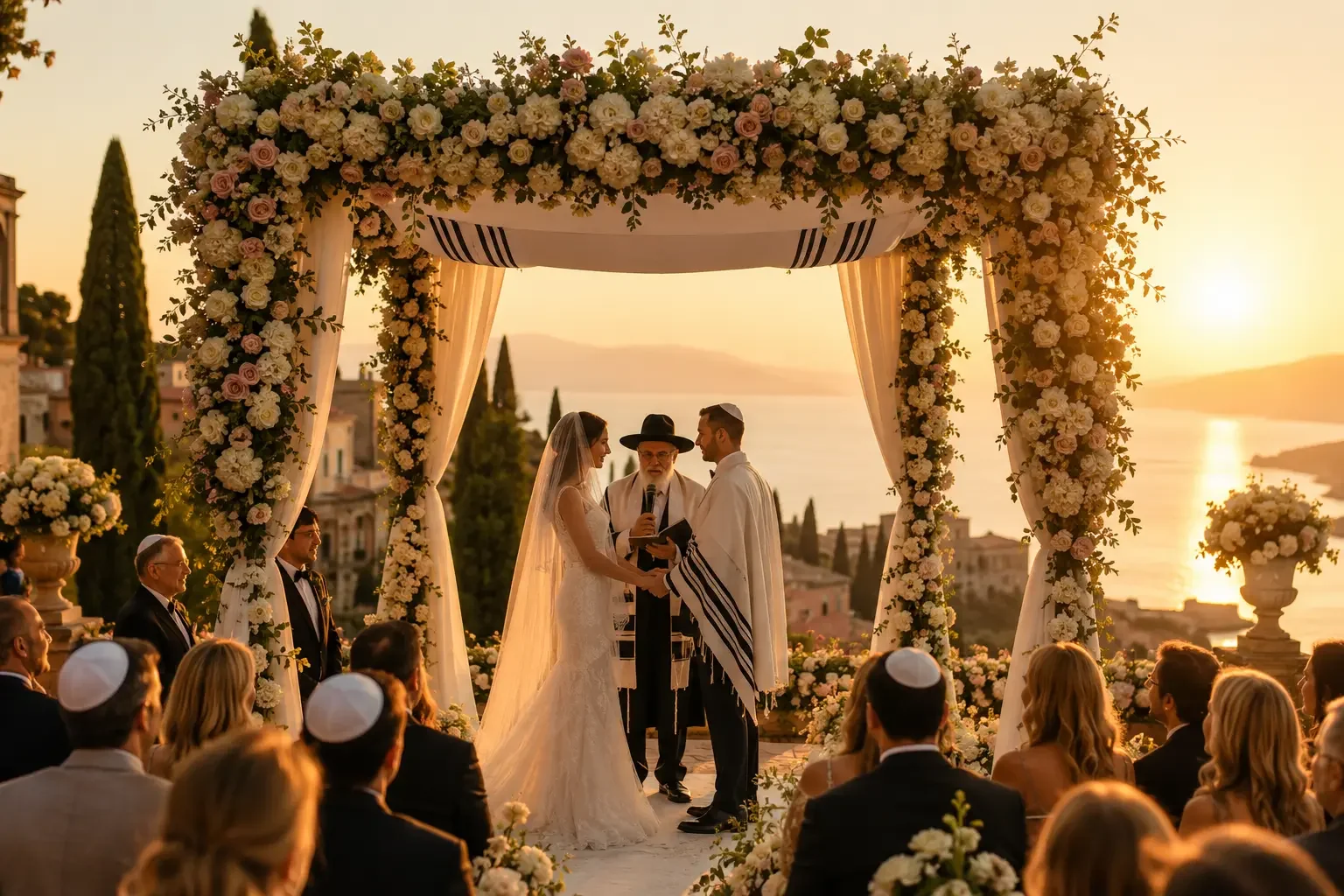
There is no other destination wedding in Italy that carries the weight of this one.
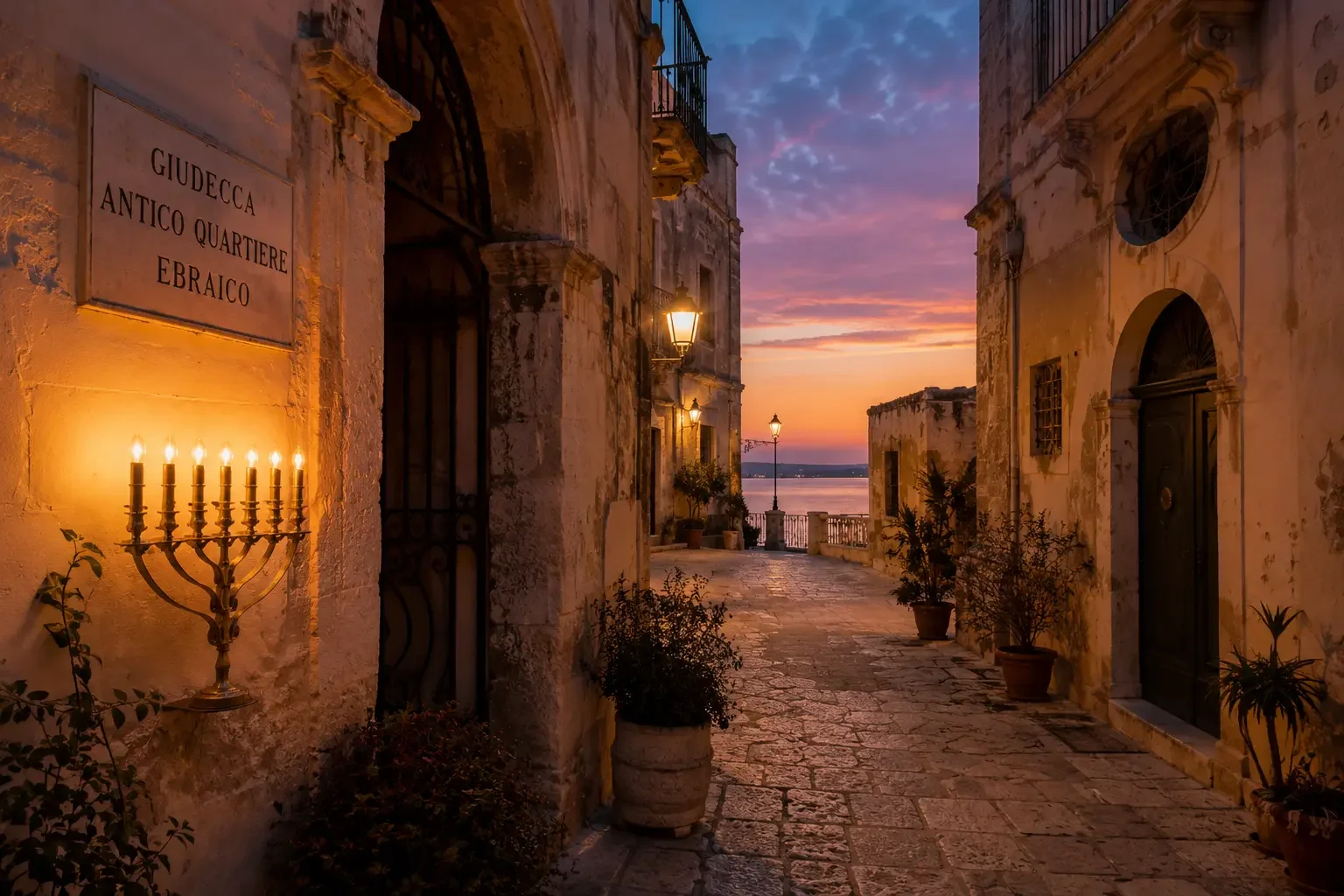
For more than a thousand years, Sicily was home to one of the largest and most deeply rooted Jewish populations in the Mediterranean. Palermo, Syracuse, Messina, Agrigento, Marsala: nearly every significant Sicilian town had its Giudecca, its Jewish quarter, woven into the fabric of the city rather than walled off from it. Palermo alone is thought to have counted around five thousand Jews, the largest of some fifty communities across the island, and in Ortigia the Jewish population made up a substantial share of the town.
Then, in 1492, the edict of the Catholic Monarchs reached Sicily, and by January 1493 the island’s Jews had been expelled. Synagogues were repurposed. Ritual baths were filled with rubble and sealed, by people who clearly expected to come back.
They are coming back: not as a community restored, but as couples. Over the last decade, more and more Jewish couples from London, New York, Tel Aviv, Paris and Melbourne have chosen Sicily for their wedding, for reasons that are both practical and something else entirely. This guide covers both: how a Jewish wedding actually works on this island, what the calendar and kashrut require of you, where to hold it, and what it means to say the Sheva Brachot a few hundred metres from a mikveh that has been waiting since 1492.
Before we begin. Jewish practice is not one thing. An Orthodox, Conservative, Reform or Liberal wedding and an interfaith ceremony each place different requirements on a venue, a caterer and a calendar, and Sephardic, Ashkenazi and Italian (Italki) customs differ in the order and detail of the rituals. What follows is a planning framework, not a halachic ruling: every decision here should be confirmed with your own rabbi, who remains the final authority on your wedding.
Why couples are choosing Sicily
- The history is not decoration
- Most destination weddings borrow a beautiful backdrop. In Sicily, if your family has Sephardic roots (and a great many Jewish families expelled from Spain and Sicily in the 1490s scattered to Salonika, Istanbul, Amsterdam and eventually New York and London), the backdrop may be ancestral. Some couples discover, in the middle of planning, that their surname appears in the records of medieval Sicilian Jewry.
- Space, and the kind a Jewish wedding needs
- Sicilian estates (bagli, aristocratic villas, wine estates) were built by families who entertained in numbers. That matters when your celebration includes a Friday night dinner, a Shabbat lunch, the wedding itself and a week of Sheva Brachot, and when your whole guest list needs to sleep within walking distance of the venue.
- Weather you can plan a chuppah around
- An outdoor chuppah, under the open sky, is the tradition. From late April through October, an outdoor ceremony in Sicily is the default rather than the gamble it is further north.
- Value
- Compared with Lake Como, Tuscany or the Amalfi Coast, Sicily offers venues of equal or greater architectural character at noticeably lower cost. When a Jewish destination wedding routinely means flying in a caterer, a mashgiach and sometimes an entire mobile kitchen, that margin is not a luxury; it is what makes the whole thing possible.
- The light
- Ask any wedding filmmaker. The long golden hour over the honey-coloured Baroque stone of the Val di Noto and the limestone of Ragusa Ibla does something to a white chuppah and a tallit that has to be seen.
Sicily’s Jewish heritage: what is still there
This is the part of the island most couples do not know about until they start looking.
The miqwe of Ortigia, Syracuse
Rediscovered in the late 1980s during restoration work on a palazzo in the Giudecca, the ritual bath lies deep below street level, reached by a stairway carved into the rock, with stone basins still fed by fresh groundwater. Some scholars date it as early as the Byzantine period, which would make it one of the oldest surviving Jewish ritual baths in Europe. It is open to visitors by guided tour.
A synagogue again in Palermo
In 2017, on the anniversary of the January 1493 expulsion, the Archdiocese of Palermo granted the city’s small Jewish community the use of the Oratory of Santa Maria del Sabato, part of a complex built over the ruins of Palermo’s medieval Great Synagogue, so that the city could once again have a synagogue after more than five centuries.
The quarters themselves
The Giudecca of Ortigia, the streets around Palermo’s Palazzo Marchesi and Palazzo Steri, the Jewish district of Agrigento, and traces in Marsala, Messina and Modica. Many couples build a heritage day into the wedding week (a guided walk, a visit to the miqwe), and it is often the moment guests remember longest.
The miqwe survived because the community, forced into exile, filled it with rubble and sealed it rather than let it be desecrated.
The structure of a Jewish wedding in Sicily
Every family shapes it differently, but a Jewish destination wedding usually spreads across a long weekend rather than a single day, which suits Sicily perfectly.
Thursday or Friday: arrivals and the aufruf
Guests arrive from all over the world. Many couples open with a relaxed welcome evening (Sicilian aperitivo, local wine, a courtyard) before the rhythm of the weekend takes hold. Where the couple is observant, the groom’s aufruf and a Shabbat Kallah for the bride are scheduled around the Friday.
Some brides arrange a mikveh immersion before the wedding. In Sicily this needs early planning and a conversation with your rabbi: the Ortigia miqwe is an archaeological site, not a functioning ritual bath, so most couples arrange immersion at home before travelling, or on the mainland.
Friday evening and Saturday: Shabbat
This is the single biggest structural difference between a Jewish destination wedding and any other, and it shapes everything.
No wedding can take place on Shabbat, from sunset on Friday to nightfall on Saturday. For observant guests, Shabbat also means no driving, no photography, no filming and no electronic music. The practical consequence in Sicily is significant: the venue and your guests’ accommodation need to be within walking distance of each other, or the whole Friday-to-Saturday arc collapses.
That narrows the shortlist considerably, and it is the question to ask first, before the ceremony space and before the view. Estates with substantial on-site accommodation, or venues in walkable historic centres such as Ortigia, work; a beautiful villa forty minutes from the nearest hotel does not.
Done well, Shabbat becomes the most memorable part of the weekend: a long Friday night dinner under a pergola, Kiddush and challah, and a slow Saturday of conversation and rest before the celebration begins.
Saturday night or Sunday: the wedding
Because Saturday is out, Jewish weddings in Italy usually fall on Sunday, or on a Saturday evening after Havdalah, which in a Sicilian June, with sunset after 20:00, means a late start and a ceremony under artificial light. Sunday is the more common choice, and Thursday is a traditional alternative worth considering.
The day itself follows the familiar arc.
- The tisch and the bedeken
- The groom’s tisch, a gathering of song, learning and interruption, and the bedeken, when the groom veils the bride. In our experience, the bedeken is consistently the most emotionally charged ninety seconds of the entire day.
- The chuppah
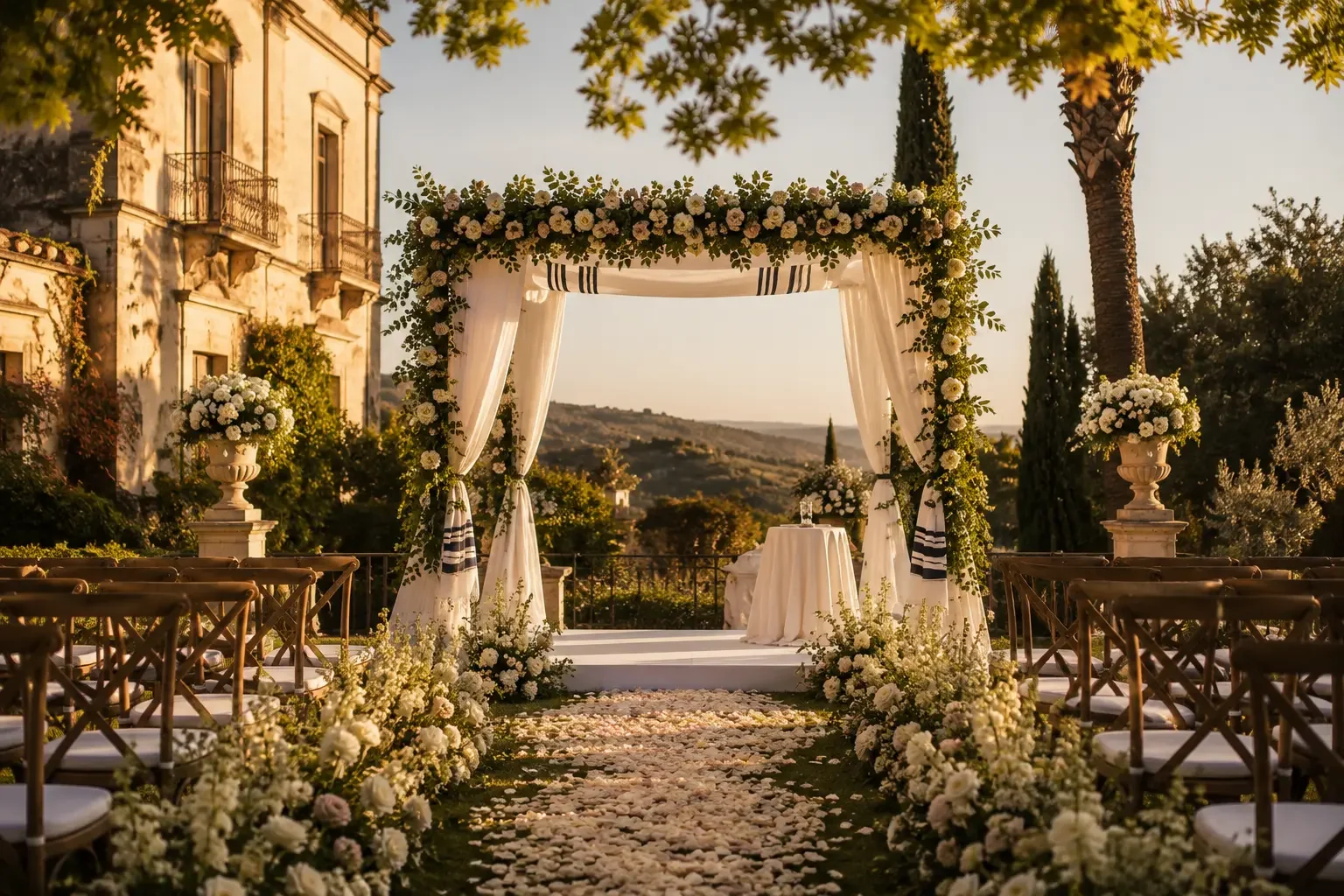
- The canopy, open on all sides, traditionally beneath the open sky. Sicilian florists and set designers have become genuinely capable here, with two technical notes from the field: make sure the structure is built for coastal wind (an afternoon breeze on a terrace in Taormina or Scopello is not theoretical), and check the venue’s open-flame policy if candles are part of your design.
- Beneath the chuppah
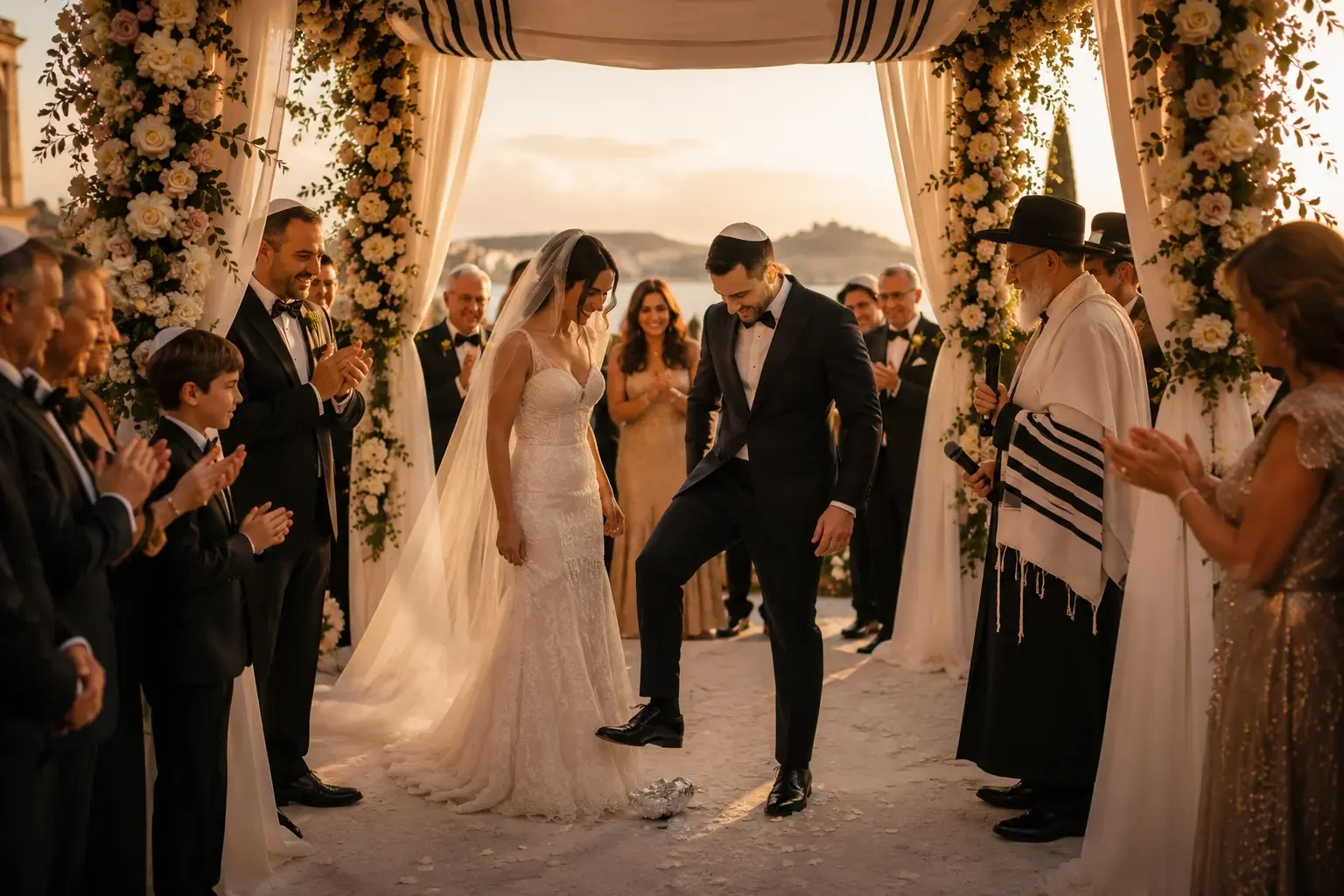
- The kiddushin and the ring, the reading and signing of the ketubah, the Sheva Brachot (the seven blessings, often shared among honoured family members) and the breaking of the glass, followed by the loudest mazel tov the island has heard in five hundred years.
- Yichud, then the party
- The couple’s private time together, then the hora, the chair lifts, the Simchat Chatan v’Kallah, and a dinner that increasingly blends the two food cultures within kosher limits.
The week after: Sheva Brachot
Traditionally, the seven blessings are repeated at festive meals during the seven days after the wedding. Many destination couples host one or two of these in Sicily before guests disperse (a lunch on the coast, a dinner in a courtyard), a lovely way to let the celebration wind down instead of ending abruptly.
The practical questions every couple asks
Can we bring our own rabbi?
Almost always, yes, and almost always you should. Sicily’s Jewish presence today is small: the community around Palermo is counted in dozens, and there is none of the communal infrastructure found in Rome, Milan or Venice. The great majority of couples marrying here bring their own rabbi from home, which is also the right choice halachically: your rabbi knows your family, your minhagim and your ketubah.
Budget for the rabbi’s travel and accommodation for the whole Shabbat, not just the wedding day.
Is a Jewish wedding in Sicily legally binding?
Usually not on its own, and that is fine. Here is how it actually works.
Italian law does recognise Jewish marriage. Under Article 14 of Law 101/1989, which ratified the state’s agreement with the Union of Italian Jewish Communities, a marriage celebrated in Italy according to Jewish rite has civil effect when it is celebrated before a minister of religion who holds Italian citizenship, the banns are published at the town hall, and the act is sent to the civil registrar within five days to be transcribed.
The catch for international couples: a visiting rabbi from London or New York does not meet the citizenship requirement. So the usual route is one of two.
- Symbolic religious ceremony in Sicily, legal marriage at home
- Simpler, faster, and no constraints on the ritual. This is what most international couples do.
- Civil ceremony at the comune, plus the religious chuppah
- A short civil rite at the town hall or an authorised venue, the same week or before travelling, followed by the full Jewish ceremony.
Either way, start the paperwork conversation with your planner at least six months ahead: nulla osta requirements differ by nationality, and UK, US, Israeli and Australian couples each face slightly different documents.
When can we actually get married? The calendar problem
This is the question that catches couples out, because the Jewish calendar removes a surprising amount of the Sicilian season.
Weddings are traditionally not held on Shabbat, on major festivals, during much of the Omer (the seven weeks between Pesach and Shavuot, with Lag BaOmer as the well-known exception) or during the Three Weeks leading to Tisha B’Av, which usually falls in July or early August. Laid over the Sicilian season, the picture sharpens.
| Month | Jewish calendar | Sicilian season |
|---|---|---|
| January – February | Permitted | Low season |
| March | Permitted | Mild |
| April | Pesach: normally not held | Mild |
| May | Omer: mostly restricted | Peak |
| June | Permitted after Shavuot | Peak |
| July | Three Weeks: normally not held | Hot |
| August | Check the date | Hot |
| September | Autumn festivals: partly restricted | Peak |
| October | Permitted | Peak |
| November – December | Permitted | Low season |
- June
- After Shavuot, warm, long evenings, before the Three Weeks: the strongest single window of the year.
- Late August to early October
- Excellent, once Tisha B’Av has passed and if your date clears the autumn festivals.
- April and May
- Usually restricted by Pesach and the Omer, exactly when Sicily starts to look its best.
- July
- Normally blocked by the Three Weeks, and punishing at midday in any case.
The Jewish calendar is lunisolar, so these periods shift by a few weeks each year, and August and September in particular move between states. Treat this as the shape of the problem, not as your dates.
Ask your rabbi to confirm the permissible dates before you contact any venue.
Sicilian venues sell their best dates twelve to eighteen months ahead, and there is nothing more painful than falling in love with a property and then discovering that the only available Sunday falls inside the Omer.
Can we get kosher catering in Sicily?
Yes, but let us be precise, because this is where budgets and timelines are made or broken.
There is no permanent kosher kitchen or kosher certification body on the island. Kosher catering in Sicily is an imported operation, and it works in one of three ways: a specialist kosher caterer travels in with their own team, ingredients and supervision; the venue kitchen is kashered for the event under a mashgiach; or a full mobile kosher kitchen is installed on site, the most robust option for glatt kosher and the most demanding logistically.
Three things to confirm with any venue before you sign, in this order:
- Does it allow external caterers with full kitchen access?
- Not every historic villa does. This is a deal-breaker, not a detail.
- What is the power capacity, and is there space for a mobile kitchen?
- Ask for numbers, not reassurance.
- Is there a service route that keeps the kosher operation separate?
- A mashgiach cannot supervise a kitchen with three doors and a shared corridor.
Kosher wine, mevushal or not depending on your requirements, is imported and should be ordered early: it is not something you find in Ragusa the week before. Budget realistically, too: kosher catering in a destination without local infrastructure generally costs noticeably more than a comparable non-kosher menu, and your planner should give you a number early, not late.
How far in advance should we book?
Twelve to eighteen months, and eighteen is not paranoid. You are coordinating a venue with walkable accommodation, a permissible date, an imported caterer, rabbinical supervision and a travelling rabbi, and each of those constrains the others.
How do guests get here?
Catania and Palermo both have strong European connections; guests from Israel usually connect through Rome, Milan or Athens, and seasonal direct routes are worth checking. For the Baroque south-east (Ragusa, Noto, Syracuse), Catania is the gateway, an hour to an hour and a half by road, with Comiso even closer. Block bookings and coordinated transfers are standard, with one addition specific to your wedding: transfers must be scheduled around Shabbat, not through it.
Where in Sicily
Five parts of the island suit a Jewish wedding weekend particularly well, each for different reasons.
Syracuse and Ortigia
For a Jewish wedding, Syracuse is the most resonant place on the island. Ortigia is a sea-wrapped Baroque island city where the Giudecca and the ancient miqwe sit a few walkable streets from hotels, restaurants and ceremony spaces, which solves the Shabbat walking problem better than almost anywhere else in Sicily. Larger villa venues in the surrounding countryside can host the reception.
The Baroque south-east — Ragusa, Modica, Scicli, Noto
UNESCO-listed towns of golden stone and a dense concentration of large private estates with substantial on-site accommodation, exactly what a Shabbat-inclusive weekend requires. The country villas around Noto and Scicli make the multi-day format easy to stage. This is our home territory, and for this kind of wedding we think it is the island’s strongest option.
Palermo and the west
Palermo carries the deepest Jewish history on the island and, once again, a synagogue. Its Arab-Norman architecture, itself a record of centuries of layered coexistence, has a resonance many Jewish couples find unexpectedly moving. Further west, the fortified baglio estates and the wineries around Marsala and Menfi were built for long, large gatherings and offer serious capacity.
Taormina and the east coast
The classic postcard: terraces suspended between Etna and the Ionian Sea. Taormina offers five-star infrastructure and a walkable density of hotels, genuinely useful for Shabbat, with the trade-offs of smaller venue capacity and premium prices.
Scopello and the north-west coast
For couples who want something quieter and more elemental, Scopello and the Zingaro coast offer a chuppah against sea stacks and open water. A smaller scale, and extraordinary light.
Filming a Jewish wedding: a note from behind the camera
Some of what a wedding film has to do at a Jewish wedding is technical, and some of it is a matter of judgement.
The technical part. The chuppah is intimate and often crowded, so long lenses and a second operator matter more than movement. The Sheva Brachot are spoken quietly, often by several different people, so audio planning is not optional. The hora is fast, low-light and genuinely chaotic, and it is where most wedding videos fall apart.
The judgement part. Where the couple or their guests are observant, there is no filming on Shabbat, and that has to be agreed clearly and early, not negotiated on the day. Some families ask for no filming during specific moments under the chuppah, and some rabbis have preferences about camera positions. We ask about all of this in advance, in writing, and treat the answers as fixed.
The father’s face during the bedeken, the hands signing the ketubah, the half-second of silence before the glass breaks.
A Jewish wedding rewards a documentary instinct more than almost any other, and our approach is built around exactly those moments. If analog texture appeals to you, Super 8 suits their warmth and grain beautifully.
Frequently asked questions
Can you have a Jewish wedding in Sicily?
Yes. Sicily hosts Jewish destination weddings with historic villas, baglio estates and coastal venues able to hold the full weekend, from the Friday night Shabbat dinner to the Sunday chuppah. Kosher catering, rabbinical supervision and the chuppah are all arranged on the island, although the caterer and the rabbi are normally brought in from elsewhere.
Is a Jewish wedding in Sicily legally recognised?
Italian law gives civil effect to Jewish marriages celebrated before a minister of religion holding Italian citizenship, with banns published at the town hall and the act sent to the civil registrar within five days. Because a visiting foreign rabbi does not meet the citizenship requirement, most international couples hold a symbolic religious ceremony in Sicily and complete the legal marriage at home, or add a short civil ceremony at the comune.
Can we get kosher catering in Sicily?
Yes, but it is an imported service: there is no permanent kosher kitchen on the island. Specialist kosher caterers travel to Sicilian venues with their own team, certified ingredients and a mashgiach, and either kasher the venue kitchen or install a mobile kosher kitchen. Confirm external-caterer access, kitchen power capacity and service separation with your venue before signing.
What is the best time of year for a Jewish wedding in Sicily?
June is usually the strongest window, and late August to early October is excellent. Pesach and the Omer often restrict April and much of May, the Three Weeks usually block July, and the autumn festivals need checking against your date. The Jewish calendar shifts every year, so confirm permissible dates with your rabbi before approaching venues.
Do the venue and the hotel need to be within walking distance?
If you or your guests observe Shabbat, yes: it is the most important venue criterion and the one couples most often overlook. Observant guests will not drive from Friday sunset to Saturday nightfall, so accommodation and the Shabbat venue must be walkable. Estates with substantial on-site rooms, or walkable historic centres such as Ortigia, work best.
Does Sicily have Jewish heritage sites we can visit?
Yes. The miqwe beneath the Giudecca in Ortigia, Syracuse, is considered one of the oldest surviving Jewish ritual baths in Europe and can be visited on guided tours. In Palermo, the Archdiocese granted the Jewish community the Oratory of Santa Maria del Sabato in 2017, above the ruins of the medieval Great Synagogue in the old Jewish quarter. Many couples build a heritage day into the wedding week.
How far in advance should we book a Jewish wedding in Sicily?
Twelve to eighteen months. You are coordinating a permissible date, a venue with walkable accommodation, an imported kosher caterer, rabbinical supervision and a travelling rabbi, and each of those constrains the others. The best Sicilian venues release their prime dates well over a year ahead.
Bringing your celebration home
If you are planning a Jewish wedding in Sicily, we would be honoured to tell that story. The earlier we talk, the more of your wedding weekend we can help you shape.
Get in touch